Shuanghao's Approach to High-Gloss Cosmetic Caps
In the world of luxury beauty packaging, the cap is not just a closure. It is a statement. It is the first thing a customer sees when they pick up a skincare jar or a premium makeup product. A high-gloss, mirror-finish cap communicates quality, luxury, and attention to detail. A dull or blemished cap signals the opposite.
But achieving a true high-gloss finish on a plastic cap is extraordinarily difficult. Every scratch, every flow mark, every tiny defect is magnified by the reflective surface. The molding process must be flawless. The mold must be perfect. The material must be chosen with care.
At Shuanghao, we have developed specialized mold solutions for high-gloss cosmetic caps. This article reveals our approach to achieving mirror-finish surfaces that meet the demanding standards of luxury beauty brands.
Understanding High-Gloss Finishes
Before discussing solutions, it is essential to understand what constitutes a high-gloss finish and why it is so challenging.
Defining High-Gloss
High-gloss finishes are typically defined by SPI (Society of the Plastics Industry) standards. SPI A-1 is a diamond-buffed mirror finish with no visible tool marks. SPI A-2 is a paper-buffed high-gloss finish. SPI A-3 is a stone-buffed gloss finish.
For luxury cosmetic caps, SPI A-1 or SPI A-2 is typically required.
The Challenge of High-Gloss
High-gloss surfaces reveal every imperfection. Sink marks that would be invisible on a matte finish are glaringly obvious on a gloss finish. Flow marks become visible. Ejector pin marks cannot be hidden. Tiny scratches from handling are magnified.
The material must also be capable of achieving high gloss. Some plastics naturally produce glossier surfaces than others. Processing conditions significantly affect final gloss.
Mold Design for High-Gloss Caps
The mold is the foundation of high-gloss cap production.
Cavity Steel Selection
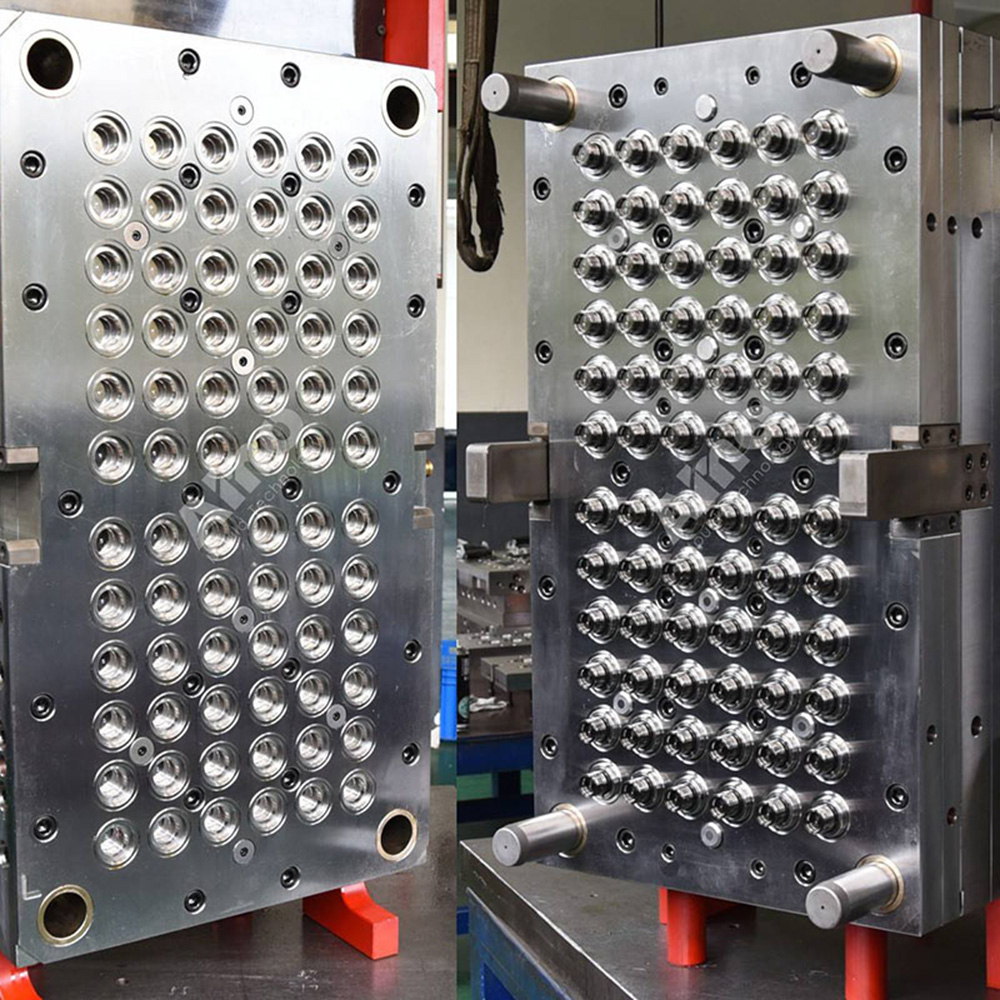
The cavity material must be capable of taking and holding a mirror polish. Shuanghao uses high-grade stainless steel (S136) or high-hardness tool steel (H13) for high-gloss cavities. These materials polish to SPI A-1 finishes without porosity or inclusions.
Steel hardness should be 48-52 HRC for good polishability and wear resistance.
Mirror-Finish Polishing
Shuanghao's polishing process for high-gloss caps follows a meticulous sequence. Diamond polishing starts with coarse diamond compounds (6-9 microns) to remove machining marks. Progressively finer compounds are used down to 1 micron and then 0.25 microns. Final diamond buffing achieves Ra 0.01-0.02 micrometers—a true mirror finish.
The polishing direction is carefully controlled to avoid swirl marks. Each cavity is polished individually by skilled technicians with decades of experience.
Surface Inspection
Every polished cavity is inspected under magnification. Surface finish is verified using profilometers (Ra measurement). Optical inspection under controlled lighting reveals any remaining defects. No cavity is approved for production until it meets the mirror-finish standard.
Gate Placement for High-Gloss
Gate location is critical for high-gloss caps. The gate must be placed where marks will be least visible—typically under the cap or on a non-visible surface. Submarine gates or valve gates are preferred for clean gate vestiges. Gate marks must be minimized; any visible mark is unacceptable.
Shuanghao uses valve gate hot runner systems for high-gloss cosmetic caps, providing clean gate vestiges with no visible mark.
Venting for High-Gloss
Proper venting prevents burn marks and surface defects. Vent depths must be precise (0.01-0.02mm for micro-vents). Vent placement must avoid visible surfaces. Shuanghao uses pin vents positioned under the cap or on non-visible edges.
Ejection for High-Gloss
Ejector pins cannot leave visible marks on high-gloss surfaces. Sleeve ejectors are preferred as they push the cap rim without marking visible surfaces. Air ejection may be used to assist release without contact. Ejector pins, if used, must be placed on non-visible surfaces such as under the cap.
Material Selection for High-Gloss Caps
Material choice significantly affects achievable gloss.
Preferred Materials for High-Gloss
High-crystallinity polypropylene (PP) can achieve good gloss with proper processing. However, PP has inherent limitations for mirror finishes. Acrylonitrile butadiene styrene (ABS) achieves excellent gloss and is common for cosmetic caps. Acrylic (PMMA) achieves the highest gloss but is more expensive. Polycarbonate (PC) also achieves high gloss.
Shuanghao works with customers to select the optimal material for their specific gloss requirements.
Material Properties Affecting Gloss
Higher melt flow index materials fill thin sections easily but may have lower gloss. Nucleated grades promote uniform crystallization, improving gloss. Impact modifiers may reduce gloss.
Color and Gloss
Pigments affect gloss. Dark colors (black, navy) show gloss well. Light colors (white, pastels) show gloss less dramatically. Pearlescent or metallic pigments can enhance perceived gloss but add molding complexity.
Process Optimization for High-Gloss Caps
Processing parameters dramatically affect final gloss.
Melt Temperature
Higher melt temperature improves surface replication, increasing gloss. However, excessive temperature causes degradation and may reduce gloss. Shuanghao recommends melt temperatures at the higher end of the material supplier's range for high-gloss applications.
Mold Temperature
Higher mold temperature is the most important factor for high gloss. Hotter molds allow better replication of the mirror-finish cavity surface. Shuanghao recommends mold temperatures of 60-80 degrees Celsius for high-gloss PP, and 70-90 degrees Celsius for ABS. Higher mold temperatures increase cycle time but are essential for gloss.
Injection Speed
Moderate to high injection speed promotes good surface replication. However, excessive speed can cause jetting or flow marks. Shuanghao recommends profiled injection speed: fast initial fill, slower at the end.
Packing Pressure
Higher packing pressure improves surface replication and reduces sink marks. However, over-packing can cause stress and ejection problems. Shuanghao optimizes packing pressure for each application.
Cooling Time
Sufficient cooling time is essential to prevent post-mold shrinkage that can affect gloss. However, extended cooling does not directly improve gloss—the surface finish is set during filling and packing.
Defect Prevention for High-Gloss Caps
High-gloss surfaces reveal defects that would be invisible on matte surfaces.
Sink Marks
Sink marks are depressions above thick sections. On high-gloss caps, even subtle sink marks are visible. Prevention includes uniform wall thickness, adequate packing pressure, gate placement over thick sections, and cooling optimization.
Flow Marks
Flow marks are visible flow patterns on the cap surface. Prevention includes higher mold temperature, higher melt temperature, optimized gate location, and profiled injection speed.
Gate Vestige
Any remaining gate material is visible on high-gloss surfaces. Prevention includes valve gate hot runners for clean gate breaks, gate placement on non-visible surfaces, and gate design that minimizes vestige.
Ejector Pin Marks
Ejector pin marks cannot be tolerated on visible high-gloss surfaces. Prevention includes sleeve ejectors instead of pins, air ejection, and pin placement on non-visible surfaces.
Scratches
Even microscopic scratches are visible on high-gloss surfaces. Prevention includes careful handling after ejection, protective packaging, and non-abrasive materials handling.
Quality Control for High-Gloss Caps
High-gloss caps require rigorous quality control.
Visual Inspection
Caps are inspected under controlled lighting. Magnification may be used to reveal subtle defects. Comparison to master samples ensures consistency.
Gloss Measurement
Gloss meters quantify surface reflectivity. Measurements are taken at consistent angles (typically 60 degrees). Gloss values are tracked statistically.
Surface Defect Inspection
Automated vision systems can detect scratches, sink marks, and flow marks. 100 percent inspection is common for high-gloss cosmetic caps.
Real-World Results: Shuanghao High-Gloss Customers
Customer Case: Luxury Skincare Jar Cap
A luxury skincare brand needed a high-gloss cap for their premium moisturizer jar. The cap required SPI A-1 mirror finish with no visible defects.
Shuanghao provided a mold with S136 stainless steel cavities polished to SPI A-1. Valve gate hot runners were used for clean gate vestiges. Sleeve ejection eliminated ejector pin marks. The cap achieved the mirror finish required. The product launched successfully and became the brand's best-selling item.
Customer Case: High-End Lipstick Cap
A cosmetics company needed high-gloss caps for a new lipstick line. The caps were small and intricate, with tight tolerances.
Shuanghao designed a multi-cavity mold with conformal cooling, precision-gated hot runners, and sleeve ejection. Material was ABS for optimal gloss. Gloss measurement averaged 92 at 60 degrees. The customer reported zero gloss-related defects.
The Shuanghao High-Gloss Advantage
Shuanghao's specialized approach to high-gloss cosmetic caps delivers mirror-finish mold polishing to SPI A-1 standards using diamond compounds and skilled technicians. Precision mold design with strategic gate placement, micro-venting, and sleeve ejection. Material selection guidance for PP, ABS, acrylic, and PC. Process optimization with high mold temperature (60-90°C), high melt temperature, and optimized injection speed. Rigorous quality control including gloss measurement, visual inspection, and automated defect detection.
Conclusion: Mirror Finish, Premium Quality
High-gloss cosmetic caps are the most demanding application in injection molding. Every defect is magnified. Every imperfection is visible. But with the right mold design, material selection, and process control, mirror finishes are achievable.
Shuanghao's specialized solutions for high-gloss cosmetic caps deliver SPI A-1 mirror finishes, defect-free surfaces, consistent gloss across all cavities, and quality that meets luxury brand standards.
Whether you produce skincare jar caps, lipstick closures, or premium beauty packaging, Shuanghao has the expertise to deliver high-gloss caps that impress.
Choose Shuanghao. Choose mirror-finish quality.