Sustainable Cap Molding: Reducing Material Waste with Shuanghao's Precision Tooling
The global packaging industry is under unprecedented pressure to reduce plastic waste. Consumers demand sustainable products. Regulators impose stricter environmental standards. Brands commit to circular economy goals. And every kilogram of plastic that ends up as waste rather than product represents both an environmental failure and a financial loss.
For bottle cap manufacturers, the path to sustainability runs through the mold. Every gram of material saved per cap multiplies across millions of caps into tons of annual waste reduction. Every scrap part eliminated saves both material and the energy used to produce it. Every efficiency improvement reduces the carbon footprint of every cap.
At Shuanghao, we have made sustainability a core design principle. Our precision cap mold tooling is engineered to reduce material waste at every stage of production. This article reveals how.
The Waste Problem in Cap Molding
Before discussing solutions, it is essential to understand where waste occurs in cap molding.
Runner Systems
Conventional cold runner molds produce significant scrap. The runner system—the channels that deliver molten plastic to the cavities—solidifies with each shot and is discarded. For a 48-cavity cap mold with a typical cold runner, the runner can weigh 50 to 100 grams per shot. At a 6-second cycle time, that is 30 to 60 kilograms of waste per hour, 240 to 480 kilograms per shift, over 100 tons per year.
Startup and Changeover Scrap
Every mold startup produces scrap while process parameters stabilize. Every material or color change produces scrap as the previous material is purged. These waste events can produce kilograms to tens of kilograms of scrap per occurrence.
Rejected Parts
Parts that fail quality inspection represent both material waste and the energy, labor, and capital cost of producing them. Rejection rates of 1 to 3 percent are common in cap molding, representing significant waste over time.
Weight Variation
Caps that are consistently heavier than the minimum required weight waste material on every single cap. A cap that is 0.1 gram overweight consumes an extra 100 kilograms of material per million caps.
Runnerless Molding with Hot Runner Systems
The most significant waste reduction opportunity in cap molding is eliminating the runner.
How Hot Runners Work
Hot runner systems keep the plastic molten within the mold. Instead of solidifying and being discarded, the material remains fluid for the next shot. Only the caps themselves are ejected. There is no runner scrap.
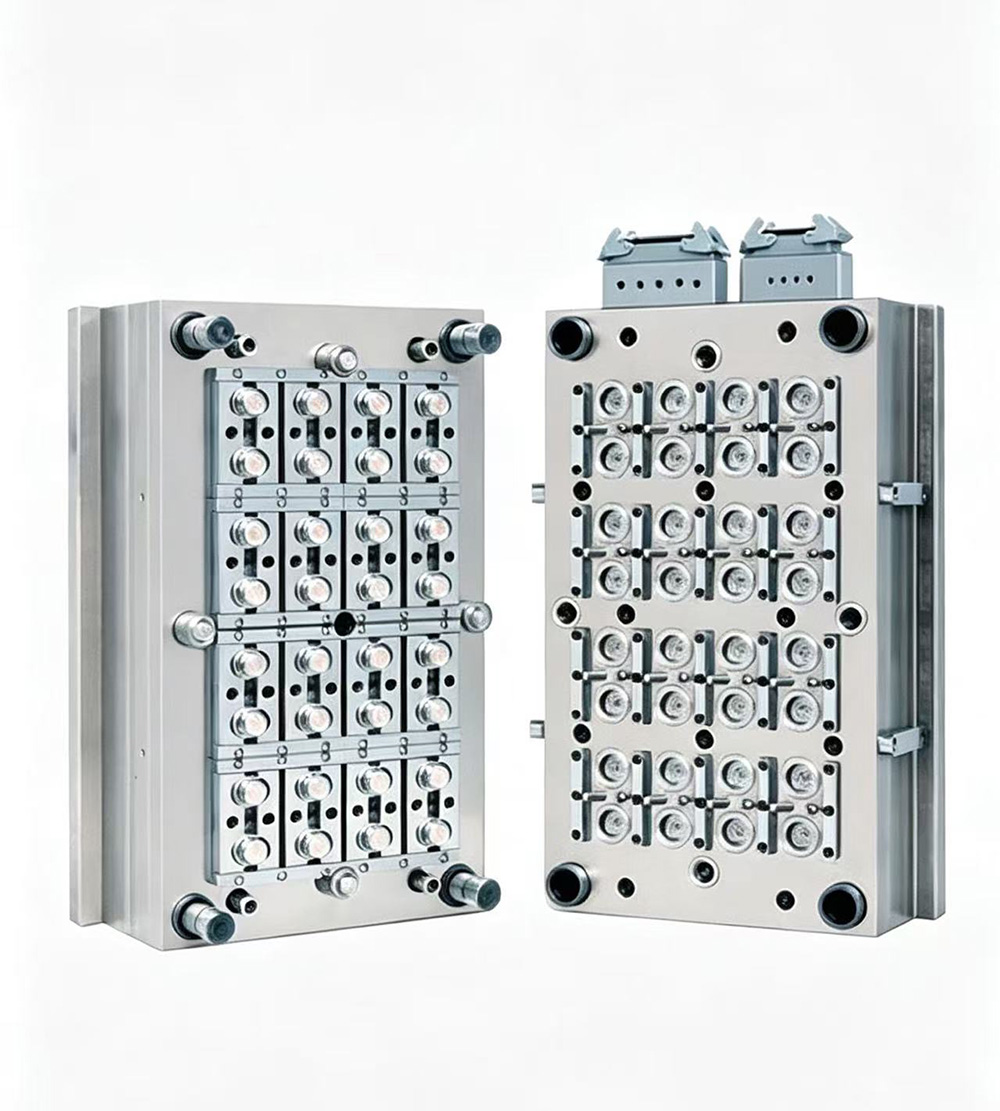
Shuanghao's hot runner systems are specifically engineered for cap molding applications.
Material Savings from Hot Runners
Eliminating the runner reduces material consumption by 15 to 30 percent depending on cap size and runner design. For a typical 3-gram cap with a 1.5-gram cold runner, switching to a hot runner reduces material use by 33 percent. For a manufacturer producing 100 million caps annually, this saves 150 tons of plastic per year.
Energy Savings from Hot Runners
Eliminating the runner also saves energy. The material that would have been discarded as runner scrap no longer needs to be reground, dried, and reprocessed. The energy required to melt the material is used only for the caps themselves, not for material that will be discarded.
Shuanghao's Hot Runner Features
Shuanghao's hot runner systems for cap molds include geometrically balanced flow channels for equal melt delivery to every cavity, individual nozzle temperature control for precise thermal management, valve gate technology for clean gate marks and consistent packing, leak-proof construction for long-term reliability, and quick color change capability for flexible production.
Weight Optimization Through Precision Tooling
Every cap has a minimum weight required to meet performance specifications. Shuanghao's precision tooling helps manufacturers achieve that minimum consistently.
Thin-Wall Cap Design
Shuanghao's molds are designed to produce caps with thinner walls while maintaining strength and sealing performance. Advanced filling analysis ensures complete cavity fill even with thinner wall sections. Precision cooling prevents warpage and dimensional variation in thin-wall designs. High-cavitation molds maintain productivity despite thinner walls.
Consistent Wall Thickness
Shuanghao's precision cavity manufacturing ensures wall thickness variation of less than 0.03 millimeters across all cavities. This consistency allows manufacturers to run at minimum weight without risk of thin spots that would cause failures.
Weight Reduction Results
Shuanghao customers typically achieve cap weight reductions of 10 to 20 percent compared to conventional molds. For a 3-gram cap, this saves 0.3 to 0.6 grams per cap. For a manufacturer producing 100 million caps annually, this saves 30 to 60 tons of plastic per year.
Scrap Reduction Strategies
Beyond runner elimination and weight optimization, Shuanghao implements multiple strategies to reduce scrap.
Cavity-to-Cavity Consistency
Inconsistent filling between cavities forces manufacturers to set processes based on the worst-performing cavity. Shuanghao's balanced hot runner systems ensure cavity-to-cavity weight variation of plus or minus 0.02 grams or less. This consistency allows processes to be optimized for all cavities simultaneously, reducing scrap from over-packed or under-filled cavities.
Process Stability
Shuanghao's robust mold construction maintains consistent performance over long production runs. Precision alignment systems prevent flash that would create scrap. Consistent cooling prevents warpage that would cause rejection. Durable components maintain performance over millions of cycles.
Startup Scrap Reduction
Shuanghao molds are designed for rapid thermal stabilization. Reduced thermal mass allows the mold to reach operating temperature faster. Pre-programmed warm-up profiles optimize the heating sequence. Temperature sensors provide real-time feedback for process control. These features reduce startup scrap by 50 to 70 percent compared to conventional molds.
Changeover Scrap Reduction
Quick-change features minimize scrap during material or color changes. Accessible purge paths allow efficient material displacement. Standardized interfaces enable fast mold changes. Minimal dead zones prevent material trapping. These features reduce changeover scrap by 40 to 60 percent.
Regrind and Recycling Considerations
Even with optimized processes, some waste is inevitable. Shuanghao's tooling supports effective regrind utilization.
Regrind-Compatible Design
Shuanghao molds are designed to process material containing up to 30 percent regrind. Runner systems accommodate the different flow characteristics of regrind blends. Gate designs prevent clogging from regrind particles. Cooling systems manage the thermal properties of recycled material.
Virgin-Regrind Blend Optimization
Shuanghao provides process recommendations for optimizing virgin-regrind blends. Melt temperature adjustments compensate for regrind degradation. Injection speed modifications improve fill with regrind blends. Back pressure changes enhance mixing of virgin and recycled materials.
Life Cycle Considerations
Sustainability extends beyond production to the mold itself.
Mold Longevity
Shuanghao molds are built to last. Premium tool steel construction provides wear resistance for 10 to 20 million cycles. Replaceable wear components extend mold life indefinitely. Refurbishment services restore molds to original specifications. Longer mold life means fewer molds manufactured, reducing the environmental impact of mold production.
Component Replaceability
Modular cavity inserts can be replaced individually rather than scrapping entire mold plates. Standardized components reduce spare parts inventory. Wear components are designed for easy replacement. This approach extends mold life and reduces waste.
Measuring Sustainability Performance
Shuanghao helps customers measure and improve their sustainability performance.
Key Performance Indicators
Material efficiency is measured as grams of material per cap, with target reduction of 10 to 20 percent. Scrap rate is measured as percentage of total production, with target reduction of 50 to 75 percent. Runner waste is measured as percentage of total material, with target of zero for hot runner molds. Energy consumption is measured as kilowatt-hours per thousand caps, with target reduction of 15 to 25 percent.
Sustainability Reporting
Shuanghao provides documentation to support customer sustainability reporting. Material savings calculations quantify waste reduction. Energy savings estimates support carbon footprint reduction claims. Scrap reduction data demonstrates process efficiency improvements.
Real-World Results: Shuanghao Sustainability Customers
Customer Case: Major Bottled Water Company
A major bottled water company committed to reducing plastic waste by 25 percent across their packaging operations. Cap manufacturing was a key focus area.
Shuanghao provided 72-cavity hot runner cap molds with precision weight optimization.
Results included material savings of 28 percent from runner elimination, cap weight reduction of 12 percent through thin-wall design, scrap rate reduction from 2.5 percent to 0.6 percent, and annual plastic waste reduction of over 200 tons. The company achieved their sustainability target 18 months ahead of schedule.
Customer Case: Regional Dairy Processor
A regional dairy processor needed to reduce material costs and environmental impact for their bottle cap production. Existing cold runner molds were producing significant runner scrap.
Shuanghao converted their production to hot runner molds with precision weight control.
Results included elimination of 45 tons of annual runner scrap, cap weight reduction of 8 percent, annual material cost savings of $120,000, and payback period of 11 months.
The Shuanghao Sustainability Advantage
Shuanghao's precision cap mold tooling delivers sustainability through runnerless hot runner systems that eliminate 15 to 30 percent of material waste, weight optimization that reduces cap weight by 10 to 20 percent, cavity-to-cavity consistency that minimizes rejected parts, process stability that reduces startup and changeover scrap, regrind compatibility that enables material recycling, and long mold life that reduces manufacturing environmental impact.
Conclusion: Sustainable Cap Molding Is Achievable
Material waste in cap molding is not inevitable. With precision tooling and optimized processes, manufacturers can dramatically reduce waste while maintaining or improving productivity.
Shuanghao's sustainable cap molding solutions deliver runnerless production through advanced hot runner technology, weight-optimized caps through precision cavity design, minimal scrap through cavity-to-cavity consistency and process stability, regrind compatibility for material recycling, and measurable sustainability performance through documented savings.
Whether you are responding to regulatory pressure, brand commitments, or consumer demand, Shuanghao has the precision tooling to help you achieve sustainable cap molding.
Choose Shuanghao. Choose sustainable cap molding. Choose less waste.