The Role of Cooling Water Quality in Cap Mold Performance and Longevity
In injection molding, cooling water is often treated as an afterthought—a utility that simply needs to be present. Yet the quality of cooling water directly affects mold performance, part quality, and tool longevity. Poor water quality creates problems that are expensive to fix and difficult to diagnose.
At Shuanghao, we recognize cooling water quality as a critical factor in mold engineering. This article explores why water quality matters and how to manage it effectively.
The Risks of Poor Water Quality
Scale and Mineral Deposition
Tap water and untreated cooling water contain dissolved minerals that precipitate as scale when heated. Over time, scale accumulates inside cooling channels, reducing flow rate and heat transfer efficiency . This slows cooling, extends cycle times, and creates uneven temperature distribution that causes warpage and dimensional variation.
A patent addressing this issue notes that conventional cooling methods using tap water containing scale "easily cause blockage inside the mold, making the mold cooling effect slow" . The solution requires either frequent descaling or alternative cooling water sources.
Corrosion and Rust
Water that is too cold can cause severe condensation on machines and molds, "easily rusting and oxidizing the machine itself," which "has a serious impact on the service life of the machine and the hygiene and safety of the bottle cap" . Corrosion damages cavity surfaces, ruins surface finish, and creates pitting that transfers to every cap produced.
Condensation and Surface Defects
When cooling water is too cold relative to ambient conditions, condensation forms on mold surfaces. This moisture can cause large watermarks on the cap surface, "affecting the appearance of the product" . For high-gloss cosmetic caps, such defects are unacceptable.
Temperature Imbalance: A Related Concern
If water temperature is too high, other problems emerge, including "pulling the screw teeth of the bottle cap" and "difficulty in demoulding" . This creates defective parts and production interruptions.
The challenge is particularly acute for components with different cooling requirements. A dual-temperature cooling system allows upper and lower molds to operate at different temperatures, enabling "wall thickness and requirements of different bottle caps" to be properly controlled .
Cooling System Design for Water Quality Management
Direct Cooling of Critical Components
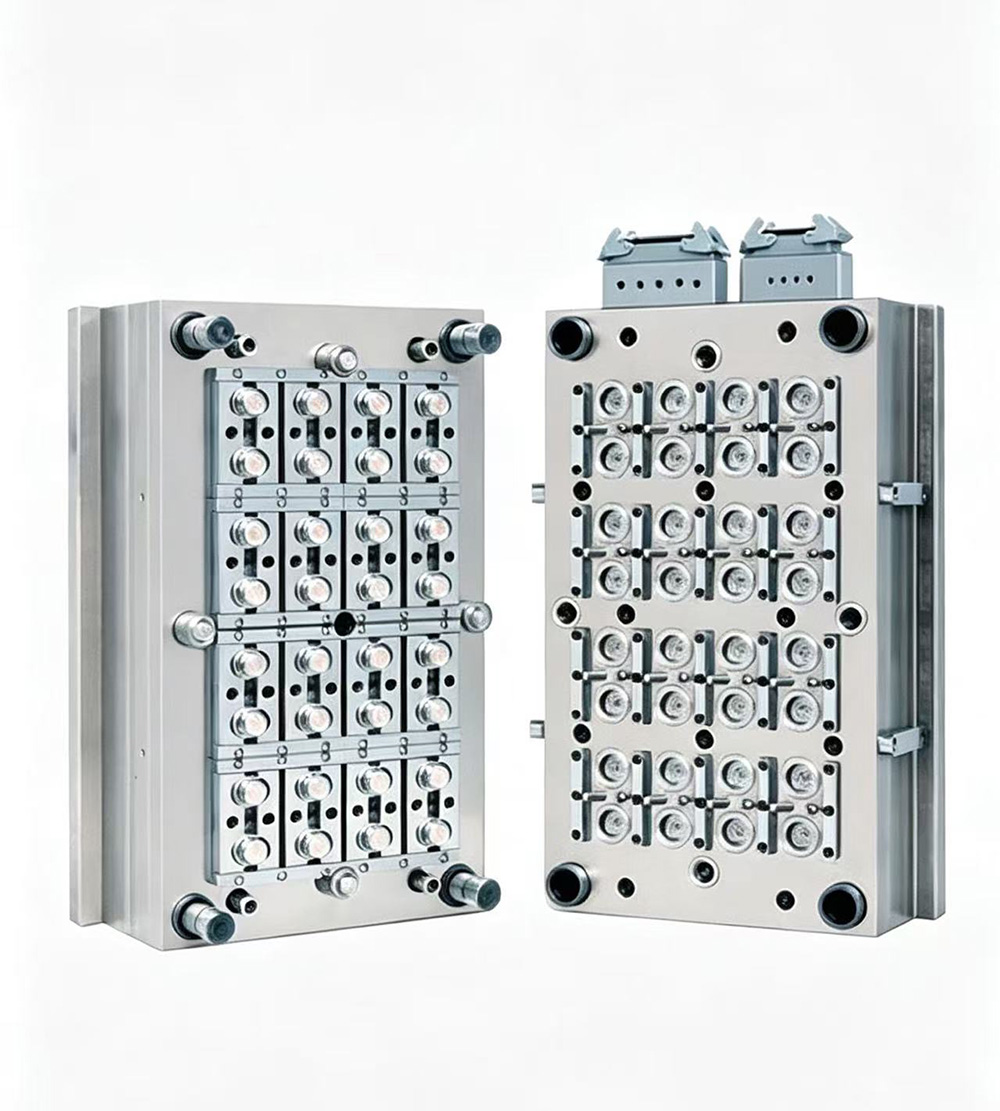
Advanced mold designs incorporate cooling directly into critical components. One design features cooling water holes in the core rod, with "cooling water holes connected to water circuits through water distributors and water distribution inserts," enabling direct cooling of the core . Direct cooling accelerates heat removal and reduces the thermal load on the cooling water system.
Separate Upper and Lower Mold Circuits
Separate cooling circuits for upper and lower molds allow independent temperature control. One system design uses "the upper mold and the lower mold separately equipped with cooling loops," with each loop having its own cooler . This independence prevents temperature conflicts and enables fine-tuning for different cooling requirements.
Optimized Channel Layout
Research on cap mold cooling channels shows that cooling channel design significantly affects cooling efficiency. Studies comparing four different conformal cooling designs found that optimized channel geometry reduced demolding time by up to 21.1% and improved surface temperature uniformity .
Managing Water Quality: Practical Measures
Use Treated Water
Closed-loop cooling systems with treated water reduce scale and corrosion risks. A patent describes a "recyclable cooling structure" where cooling liquid "can be recycled" and "does not contact outside air during the flow process," reducing impurities that would otherwise enter the cooling liquid and "reduce the cooling effect of the mold" .
Filter Cooling Water
Filtration removes particulates that can accumulate in narrow cooling channels. This is especially important for molds with complex conformal cooling geometries, where channels may be smaller and more prone to blockage.
Regular Descaling
Periodic descaling removes mineral deposits before they reduce cooling efficiency. The frequency depends on water hardness and operating conditions.
Monitor Inlet and Outlet Temperatures
Temperature monitoring provides early warning of cooling problems. A significant increase in outlet temperature relative to inlet indicates reduced heat transfer, likely from scale buildup or flow restriction.
Use Temperature Control Units
Mold temperature controllers maintain consistent cooling water temperature, preventing both overcooling (condensation) and undercooling (slow cycles). This consistency also protects against thermal stress that accelerates mold wear.
Conclusion
Cooling water quality directly affects mold performance, cap quality, and tool longevity. Scale buildup reduces cooling efficiency and increases cycle times. Corrosion damages cavity surfaces and shortens mold life. Condensation creates surface defects. Temperature imbalance creates process instability.
Shuanghao's approach to cooling water management integrates proper water treatment, separate upper and lower mold circuits, direct cooling of critical components, and regular monitoring. The result is consistent cooling, stable cap quality, and extended mold life.
Choose Shuanghao. Choose proper cooling management.