Child-Resistant Cap Molding: Meeting Safety Standards with Precision Tooling
Every year, hundreds of thousands of children gain access to medications, household chemicals, and other hazardous substances. Many of these incidents result in emergency room visits. Some result in tragedy.
Child-resistant caps save lives. Since their introduction in the 1970s, child-resistant packaging has prevented countless poisonings. But a CR cap only works if it is manufactured correctly. A cap that fails to meet its design specifications is a cap that may fail to protect a child.
Manufacturing child-resistant caps to meet global safety standards requires precision tooling, rigorous quality control, and deep understanding of certification requirements.
At Shuanghao, we have specialized in child-resistant cap molds for decades. This article reveals the engineering principles and quality systems that enable reliable CR cap production.
Understanding Child-Resistant Cap Requirements
Child-resistant caps are not ordinary closures. They are medical devices in the regulatory sense, subject to testing and certification.
Regulatory Framework
In the United States, the Poison Prevention Packaging Act of 1970 established requirements for child-resistant packaging. The Consumer Product Safety Commission enforces these requirements through 16 CFR 1700. Testing protocols are defined in 16 CFR 1700.20.
In Europe, child-resistant requirements are defined in EN ISO 8317 for reclosable child-resistant packaging. Additional standards apply for specific product categories.
These regulations define the performance requirements that CR caps must meet. They do not specify how to design or manufacture the cap, only how it must perform in testing.
The Dual Mandate
CR caps must be difficult for children to open but not impossible for adults. This is the fundamental challenge of CR cap design.
Child testing requires that at least 85 percent of children aged 42 to 51 months cannot open the cap within 5 minutes, and at least 80 percent cannot open it within 10 minutes. No child may open the cap by demonstration or learning.
Adult testing requires that at least 90 percent of adults aged 50 to 70 can open and properly close the cap within 5 minutes.
A CR cap that is too difficult for adults will be defeated by frustrated consumers who leave the cap loose or transfer the product to non-CR containers. A CR cap that is too easy for children fails its primary purpose.
Types of Child-Resistant Caps
Push-and-Turn Caps
The push-and-turn cap is the most common child-resistant design. The user must push down firmly while turning to engage the threads. Without downward pressure, the cap spins freely without disengaging.
The mechanism requires a ratchet or clutch system that engages only when downward force is applied. Precision molding of these interlocking features is critical for reliable function.
Squeeze-and-Turn Caps
The squeeze-and-turn cap requires the user to squeeze two flexible side tabs while turning. The tabs flex inward to release locking lugs from the bottle neck.
These caps are common on prescription vials and some over-the-counter medications. The flexible tabs must be precisely molded to provide the correct resistance—stiff enough to resist children but flexible enough for seniors.
Other CR Mechanisms
Other child-resistant designs include push-and-squeeze caps, lift-and-turn caps, and custom mechanisms for specific applications. Each requires specialized mold design and precise manufacturing.
CR Cap Mold Design Principles
Shuanghao's CR cap molds incorporate several specialized design features.
Precision Ratchet and Clutch Features
For push-and-turn caps, the ratchet and clutch mechanism must be molded with exceptional precision. Engagement features must align perfectly between the cap and the bottle neck. Ratchet tooth geometry determines the force required to engage and disengage. Shuanghao holds ratchet feature tolerances to plus or minus 0.03 millimeters.
Flexible Tab Design
For squeeze-and-turn caps, the flexible tabs must be designed for consistent flexural properties. Tab thickness is the most critical parameter, typically 0.5 to 0.8 millimeters depending on material and cap size. Tab geometry including length, width, and hinge design affects flex force. Living hinge design for the tabs requires the same principles as flip-top cap hinges.
Undercut Management
CR caps often contain undercuts that complicate ejection. Locking lugs, retaining rings, and internal ratchets may all be undercuts. Shuanghao uses collapsible cores, lifters, and slide systems to release undercuts cleanly. Multi-stage ejection sequences allow complex features to release without damage.
Dimensional Control for Function
CR cap function depends on precise relationships between multiple features. The gap between the outer cap and inner ratchet affects push-down travel. The interference between locking lugs and bottle neck lugs affects opening force. The engagement depth of the ratchet teeth affects resistance to child opening.
Shuanghao holds critical feature relationships to plus or minus 0.05 millimeters.
Material Selection for CR Caps
Material choice significantly affects CR cap function.
Preferred Materials
Polypropylene is the most common material for push-and-turn CR caps. It offers good stiffness for ratchet engagement, good fatigue resistance for repeated use, and good chemical resistance for pharmaceutical products.
High-density polyethylene is used for some CR caps, particularly squeeze-and-turn designs. It offers greater flexibility for tab designs but lower stiffness for ratchet mechanisms.
Material Properties
Melt flow index affects fill of thin ratchet features. Shuanghao recommends MFI of 8 to 15 grams per 10 minutes for CR caps. Flexural modulus determines ratchet engagement feel and tab flexibility. Typical targets are 1,200 to 1,600 megapascals for polypropylene CR caps.
Impact resistance is critical for CR caps that may be dropped. Shuanghao recommends impact-modified grades for applications with drop-test requirements.
Testing and Certification
CR caps must be certified through accredited testing laboratories.
Protocol Testing
Protocol testing is required for new CR cap designs. The test uses 200 children aged 42 to 51 months and 100 adults aged 50 to 70. The testing is expensive and time-consuming, typically requiring several months and costing tens of thousands of dollars.
Because protocol testing is so costly, CR cap designs must be validated thoroughly before submission.
In-House Functional Testing
Shuanghao recommends in-house functional testing before protocol submission. Push-down force measurement verifies the force required to engage the ratchet. Turn torque measurement verifies the torque required to open the cap. Child simulation testing uses specialized fixtures to mimic child opening attempts.
Accelerated aging testing verifies that CR function persists over the product's shelf life.
Quality Control for CR Cap Production
Once a CR cap design is certified, ongoing quality control is essential.
In-Process Inspection
Critical dimensions are monitored in real time during production. Ratchet feature dimensions are checked at regular intervals. Tab thickness is measured for squeeze-and-turn designs. Opening torque and push-down force are verified using automated test stations.
Cavity-to-Cavity Consistency
For multi-cavity molds, every cavity must produce caps with identical CR function. Shuanghao's molds are manufactured to ensure cavity-to-cavity variation of less than 0.02 millimeters on critical features. Cavity-to-cavity functional testing verifies consistency.
Statistical Process Control
SPC charts track key dimensions and functional parameters over time. Trends are detected before they produce out-of-spec parts. Capability indices of Cpk greater than 1.33 are maintained for critical features.
Common CR Cap Defects and Solutions
Problem: Inconsistent Push-Down Force
Inconsistent push-down force indicates variation in ratchet engagement. Solutions include verifying ratchet tooth dimensions cavity to cavity, checking for flash or burrs on engagement surfaces, confirming proper assembly of outer cap to inner ratchet, and inspecting for warpage affecting engagement.
Problem: Cap Spins Without Engaging
Cap spins without engaging indicates the ratchet is not catching. Solutions include increasing ratchet tooth height, verifying ratchet tooth geometry, checking for worn mold components, and confirming proper material stiffness.
Problem: Too Difficult for Adults
Adults struggling to open the cap indicates excessive push-down force or turn torque. Solutions include reducing ratchet tooth height or engagement depth, adding lead-in ramps to engagement features, reducing tab thickness for squeeze-and-turn designs, and using lubricated or slip-modified material.
Problem: Tab Breakage
Tab breakage indicates insufficient flexural strength. Solutions include increasing tab thickness within design limits, adding radius at tab hinge points, using impact-modified material, and verifying proper mold temperature for stress reduction.
Real-World Results: Shuanghao CR Customers
Customer Case: Pharmaceutical Manufacturer
A pharmaceutical manufacturer needed a new push-and-turn CR cap for a pediatric medication. The cap had to meet all CPPA requirements while being senior-friendly. Previous attempts by other mold makers had failed protocol testing due to inconsistent push-down force.
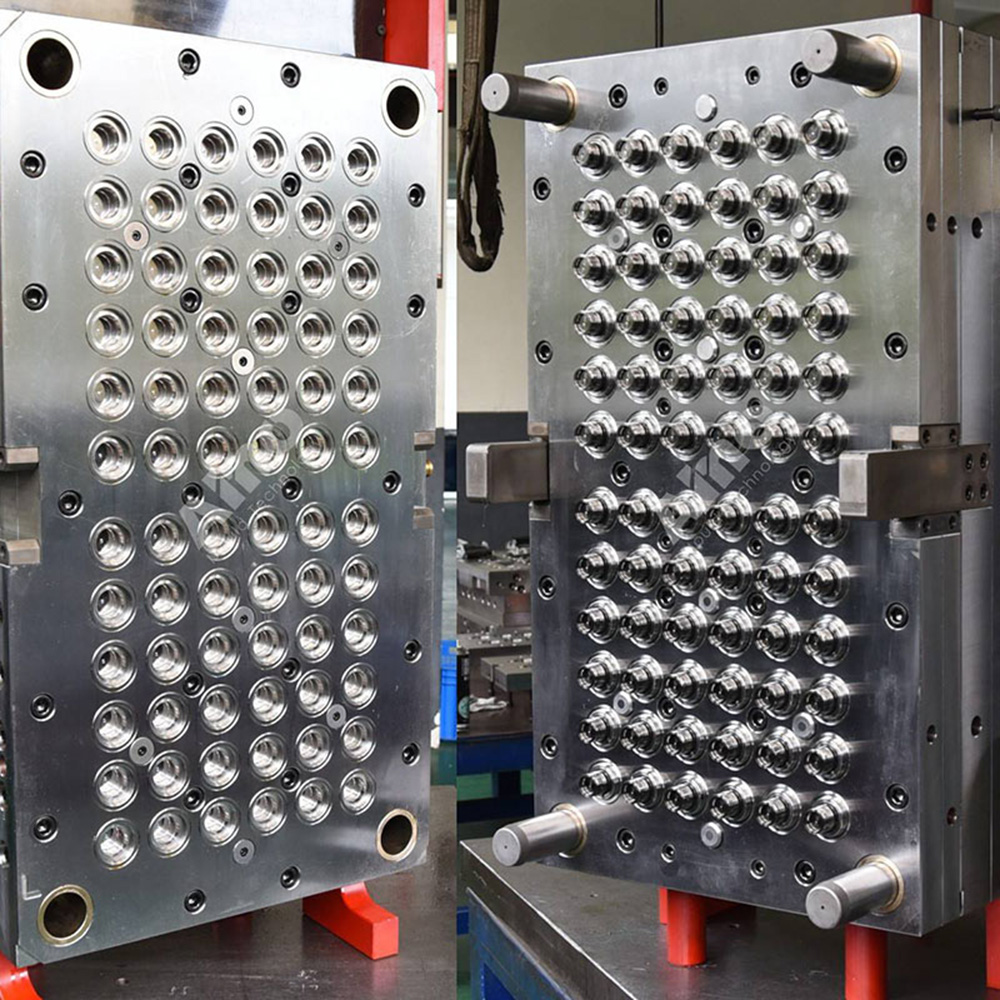
Shuanghao designed and manufactured a 48-cavity CR cap mold with precision ratchet features, balanced cooling, and comprehensive dimensional control.
The caps passed protocol testing on the first attempt. Push-down force variation across cavities was plus or minus 0.5 Newtons. Adult testing achieved 98 percent success. Child testing achieved 92 percent failure rate. The medication was launched on schedule.
Customer Case: Household Chemical Company
A household chemical company needed a squeeze-and-turn CR cap for a laundry detergent pod container. The flexible tabs had to be easy for adults but resistant to children.
Shuanghao designed a custom CR cap mold with precision tab thickness control and living hinge optimization.
The caps achieved consistent tab flex force of 8 to 12 Newtons across all cavities. Child testing achieved 88 percent failure rate. Adult testing achieved 96 percent success. The product has been on the market for three years with no CR-related safety incidents.
The Shuanghao CR Cap Advantage
Shuanghao's CR cap molds deliver precision ratchet and clutch features for reliable push-and-turn function, flexible tab optimization for consistent squeeze-and-turn performance, tight dimensional control for cavity-to-cavity consistency, material selection guidance for optimal mechanical properties, and manufacturing systems designed for certified CR cap production.
Conclusion: Safety Through Precision
Child-resistant caps save lives. But they only work when manufactured to precise specifications. A CR cap that fails to meet its design intent is a false promise of safety.
Shuanghao's precision tooling enables reliable CR cap production that meets global safety standards. Through precision mold design, tight dimensional control, comprehensive testing validation, and rigorous quality systems, we produce molds that deliver CR caps you can trust.
Whether you produce push-and-turn caps for pharmaceuticals or squeeze-and-turn caps for household chemicals, Shuanghao has the engineering expertise to meet safety standards with precision tooling.
Choose Shuanghao. Choose safety through precision.