10 Common Bottle Cap Mould Problems and Practical Solutions
10 Common Bottle Cap Mould Problems and Practical Solutions: Expert Insights by Shuanghao Mould
In the high-precision world of plastic injection molding, producing flawless bottle caps requires absolute perfection. As a leading professional bottle cap mould manufacturer, Shuanghao Mould has dedicated decades to mastering the art and science of cap production. From beverage closures to cosmetic and pharmaceutical caps, maintaining high efficiency while avoiding defects is the ultimate goal for any production line.
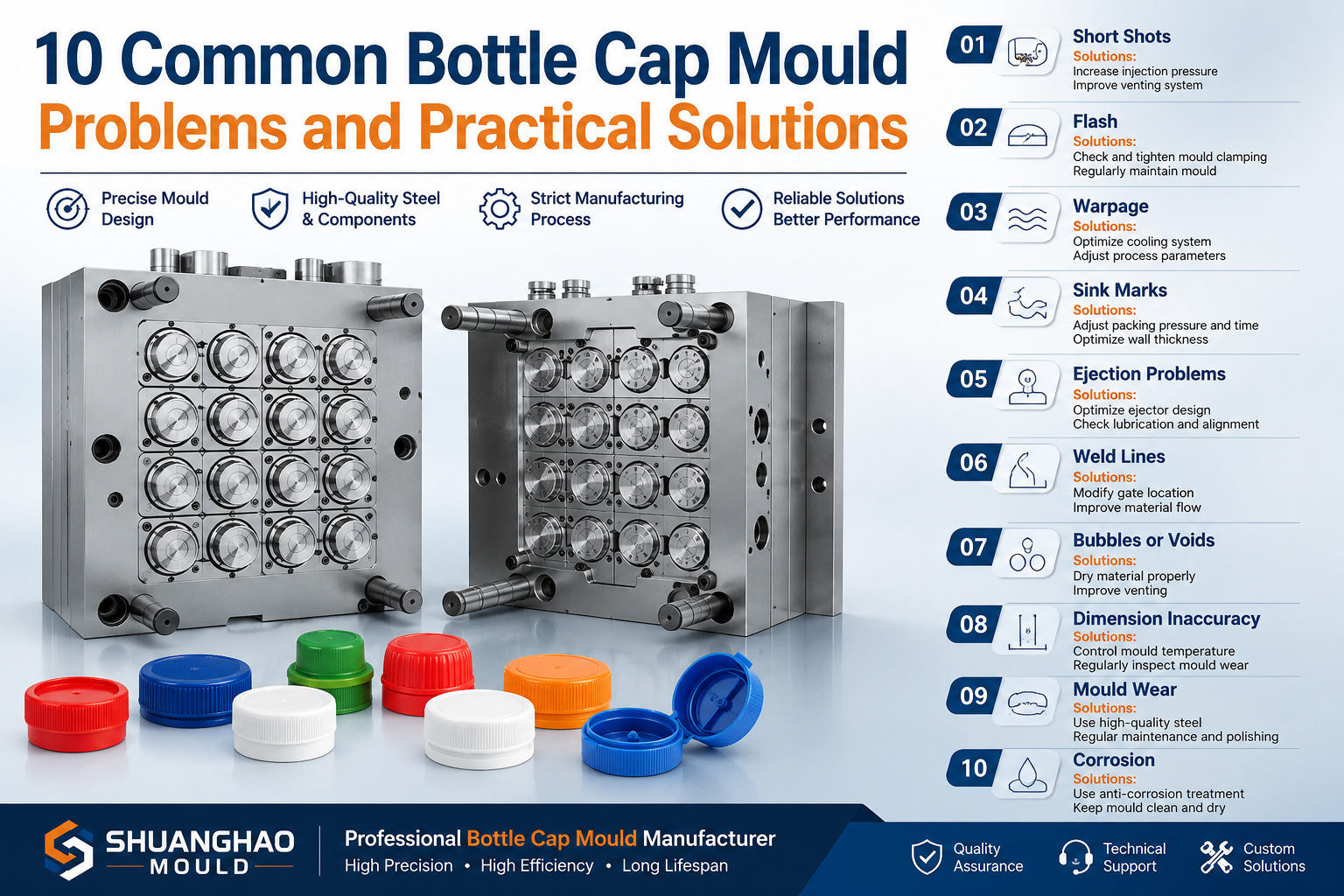
However, injection molding often throws challenges at engineers. Below, our technical experts break down the 10 most common bottle cap mould problems and provide practical, field-tested solutions to optimize your production and ensure zero-defect manufacturing.
1. Flashing (Excess Material at Seams)
The Problem:
Flashing occurs when molten plastic escapes from the mold cavity through the parting line or ejector pins, leaving unwanted thin layers of plastic on the finished bottle cap.
The Solution:
- Check Clamp Pressure: Ensure the injection molding machine has sufficient clamping force to keep the mould halves tightly sealed.
- Inspect Mould Wear: Over time, the parting surfaces of the cap mould can degrade. Precision grinding and maintenance by a professional manufacturer like Shuanghao Mould can restore perfect alignment.
- Optimize Injection Parameters: Reduce injection speed or pressure if the material is being forced out too aggressively.
2. Short Shots (Incomplete Cavity Filling)
The Problem:
A short shot happens when the plastic freezes before completely filling the bottle cap mould cavity, resulting in unfinished or structurally weak caps.
The Solution:
- Increase Material/Mould Temperature: Elevate the temperature to improve the melt flowability of resins like HDPE or PP.
- Boost Injection Pressure & Speed: Force the plastic into the intricate details of the cap (like threads and tamper-evident bands) before it cools.
- Optimize Venting: Air trapped in the cavity blocks the plastic. Ensure the mould features advanced gas venting slots.
3. Sink Marks (Surface Depressions)
The Problem:
Sink marks are shallow depressions on the exterior surface of the cap, usually occurring in thicker areas, such as internal ribs or the center of the top wall.
The Solution:
- Enhance Holding Pressure and Time: Pack more material into the cavity during the cooling phase to compensate for volumetric shrinkage.
- Optimize Wall Thickness: During the mould design phase, Shuanghao Mould utilizes advanced DFM (Design for Manufacturing) to ensure uniform wall thickness, radically reducing sink risks.
- Improve Cooling: Ensure efficient and balanced cooling water channels within the core and cavity.
4. Thread Deformation or Stripping
The Problem:
Bottle caps rely heavily on internal threads for sealing. During the ejection or unscrewing phase, threads can strip, deform, or warp, rendering the cap useless.
The Solution:
- Precise Unscrewing Mechanism: For continuous threads, implement a highly synchronized hydraulic or servo-driven unscrewing system within the mould.
- Optimize Stripper Plate Timing: For forced-ejection (snap-on) caps, ensure the material is flexible enough and the stripping angle is mathematically optimized during the tool design.
- Control Cooling Temperature: If the cap is ejected when it is too hot, the threads will deform instantly.
5. Visible Weld Lines (Knit Lines)
The Problem:
Weld lines appear where two or more flow fronts of molten plastic meet. In bottle caps, this often happens around the gate or structural ribs, creating cosmetic blemishes and physical weak points.
The Solution:
- Raise Melt and Mould Temperatures: Hotter plastic fuses together much better at the meeting fronts.
- Alter Gate Location: Reposition the injection gates to change how the material flows into the cavity, minimizing visible seams.
- Utilize Premium Hot Runner Systems: Shuanghao Mould integrates balanced hot runner systems (like balanced valve gate systems) to ensure homogenous material distribution.
6. Eccentricity and Uneven Wall Thickness
The Problem:
If the core and cavity of the cap mould shift even by a fraction of a millimeter, one side of the cap will be thicker than the other, causing capping failures on the bottling line.
The Solution:
- High-Precision Interlocking Systems: Utilize robust taper positioning blocks and precise guiding components to lock the core and cavity firmly in place.
- Rigid Mould Base Construction: Use high-grade steels (like S136 or H13) treated for maximum dimensional stability under high clamping pressure.
7. Ejection Scratches or Sticky Caps
The Problem:
Caps sticking to the cavity or core cause cycle delays and physical scratches, ruining the aesthetic appeal of premium beverage closures.
The Solution:
- Apply Superior Surface Polishing: Mirror-polishing (SPI A1/A2 standard) or applying specialized coatings like Teflon or DLC (Diamond-Like Carbon) prevents sticking.
- Optimize Draft Angles: Ensure all vertical walls and ribs have adequate draft angles to ease demolding.
- Balanced Ejection Air: Integrate air poppet valves alongside mechanical ejectors for a smooth release.
8. Tamper-Evident Band Damage
The Problem:
The safety ring or tamper-evident band at the bottom of beverage caps is incredibly delicate. It frequently tears or deforms during ejection from the mould.
The Solution:
- Segmented Slider Design: Implement highly precise collapsible cores or moving sliders to release the fragile bridges without stress.
- Fine-Tune Resin Selection: Ensure the MFI (Melt Flow Index) of the plastic resin matches the structural complexity of the bridges.
9. Burn Marks (Diesel Effect)
The Problem:
Dark, charred spots appear on the edges or tips of the cap. This is caused by trapped air being compressed so rapidly during high-speed injection that it ignites.
The Solution:
- Clean and Expand Vents: Regularly clean out gas residues from the mould vents. Enhance venting channels, especially at the last filled areas.
- Stage Injection Speed: Use a profiled injection speed (fast initially, then slowing down as the cavity fills) to let air escape.
10. Inconsistent Cap Weight and Cycle Times
The Problem:
Fluctuations in cap weight across multi-cavity moulds point to structural imbalances, affecting overall quality control and profitability.
The Solution:
- Cavity-to-Cavity Balance: Ensure every single cavity is machined to identical tolerances via CNC and EDM.
- Optimal Cooling Circuit Design: Implement independent cooling for each cavity to ensure uniform thermal shrinkage across the entire mould plate.
Partner with Shuanghao Mould – Your Bottle Cap Solution Experts
"An exceptional bottle cap starts with an exceptional mould."
At Shuanghao Mould, we don't just manufacture moulds; we engineer high-performance, high-speed, and high-durability solutions. By combining state-of-the-art multi-cavity hot runner technology, premium steel selection, and rigorous quality testing, we ensure our clients experience minimal downtime and maximum yield.
Whether you are dealing with persistent defects in your current production line or looking to invest in a brand new high-speed 24, 32, or 48-cavity bottle cap mould, our engineering team is here to support you with tailored turnkey solutions.
Contact Shuanghao Mould today to discuss your next injection molding project and elevate your production quality!