Shuanghao's Solutions for Caps with Silicone Valves
Not all caps simply open and close. Some must dispense precise amounts. Some must prevent backflow. Some must allow air to enter while preventing liquid from leaking. Some must provide a one-way passage for product.
These functions require valves. And for many applications, silicone is the valve material of choice.
Caps with silicone valves are found in condiment bottles (ketchup, mustard), personal care products (lotion, shampoo), household chemicals (dish soap, detergent), and medical devices (saline, wound care). The silicone valve allows product to flow out when squeezed or pumped, then seals tightly to prevent leakage and contamination.
Molding caps that accommodate silicone valves presents unique challenges. The valve seat must be precisely dimensioned. The valve must be retained securely. The assembly must be leak-proof. The cap must be compatible with automated valve insertion.
At Shuanghao, we have developed specialized mold solutions for caps with silicone valves. This article reveals our approach to engineering these functional closures.
Understanding Silicone Valves
Before discussing solutions, it is essential to understand what silicone valves are and how they function.
Why Silicone?
Silicone is the preferred material for dispensing valves due to its unique properties. It has excellent elasticity, returning to its original shape after deformation. It has high chemical resistance for most personal care and food products. It offers good temperature resistance for hot-fill and dishwasher applications. It provides superior sealing properties even at low compression forces.
Silicone can be formulated for different hardness levels (20-80 Shore A) to achieve desired opening pressure and flow characteristics.
Types of Silicone Valves
Duckbill valves are the most common type, shaped like a duck's beak. They open when forward pressure is applied and close when pressure is released. They are used in condiment bottles, lotion pumps, and medical devices.
Slit valves (cross-slit or single-slit) open when pressure pushes the slits apart. They are common in dish soap bottles, shampoo dispensers, and sports drink caps.
Umbrella valves allow flow in one direction only. They are used in vents and pressure relief applications.
Custom valves are designed for specific flow requirements.
Cap Design for Silicone Valves
The cap must be designed to properly seat and retain the silicone valve.
Valve Seat Design
The valve seat is the surface against which the silicone valve seals. It must be smooth to ensure proper sealing (Ra 0.4 micrometers or better). It must be flat to prevent leakage (within 0.05mm). It must be dimensionally accurate to match the valve geometry.
Shuanghao's cavity machining achieves the precision required for leak-proof valve seats.
Retention Features
The cap must hold the valve securely during use. Retention mechanisms include annular grooves that the valve snaps into, retaining ribs that press against the valve body, interference fit where the valve is slightly larger than the seat, and locking beads that engage with valve features.
Valve Seat Depth
The depth of the valve seat controls how much the valve is compressed. Insufficient compression causes leakage. Excessive compression causes difficulty opening. The optimal compression is typically 10-20 percent of valve thickness.
Valve Assembly Methods
Silicone valves can be assembled to caps using several methods.
Press-Fit Assembly
The valve is simply pressed into the cap. Retention relies on interference fit and/or retaining features. This method is low cost and suitable for many applications. It requires precise dimensional control of both valve and cap.
Shuanghao designs cap features specifically for press-fit assembly.
Overmolding
The cap is molded first, then silicone is injection molded directly onto it. This creates a permanent bond between cap and valve. It eliminates separate assembly steps. It ensures perfect valve alignment.
Overmolding requires specialized two-shot molding or transfer molding equipment. Shuanghao can design caps for overmolding and recommend appropriate manufacturing partners.
Adhesive Bonding
The valve is bonded to the cap using medical-grade adhesive. This is used for specialized applications where other methods are not suitable. It adds assembly cost and complexity.
Material Compatibility
Cap material must be compatible with the silicone valve and the product.
Polypropylene (PP)
PP is the most common cap material for silicone valves. It has good chemical resistance, good dimensional stability, and is compatible with silicone (no adhesion issues).
Shuanghao recommends PP for most silicone valve cap applications.
Polyethylene (PE)
HDPE and LDPE are also compatible with silicone. They are more flexible than PP, which may affect retention feature performance.
Other Materials
PET and other engineering plastics may be used for specialized applications. Compatibility with silicone should be verified.
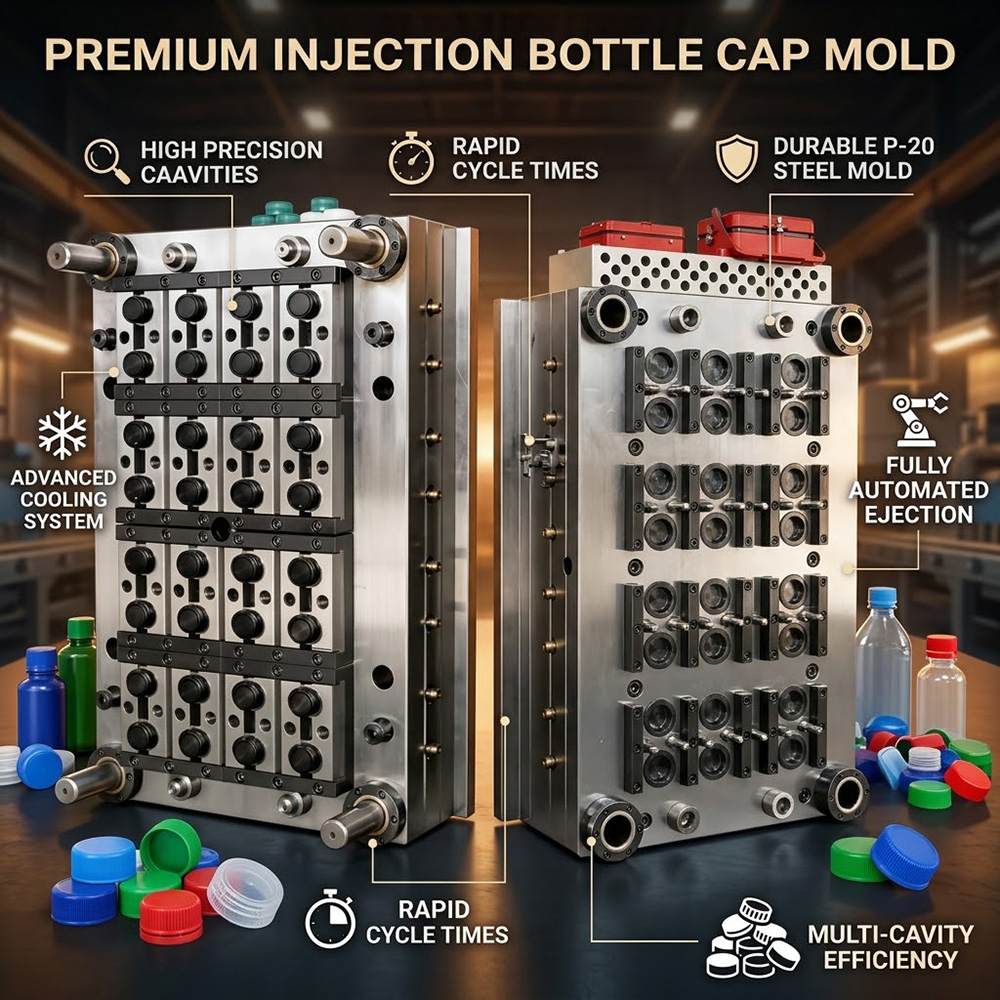
Mold Design for Silicone Valve Caps
Specialized mold design features are required for silicone valve caps.
Valve Seat Cavity
The valve seat cavity must be machined with high precision. Flatness must be held to 0.05mm or better. Surface finish should be Ra 0.2-0.4 micrometers. Ejector pins must avoid the valve seat area.
Gate Placement
Gates should be placed away from the valve seat. Gate vestige on the valve seat can interfere with valve sealing. Shuanghao positions gates on the cap sidewall or top panel.
Cooling Considerations
The valve seat area must cool uniformly to maintain flatness. Shuanghao's conformal cooling ensures uniform heat extraction. Uneven cooling can warp the valve seat, causing leakage.
Ejection System
Sleeve ejectors are preferred for silicone valve caps. They push the cap rim without contacting the valve seat. Ejector pins, if used, must be placed outside the valve seat area.
Quality Control for Silicone Valve Caps
Silicone valve caps require specialized quality control.
Valve Seat Inspection
Flatness is measured using CMM or optical methods. Surface finish is verified with profilometer. Diameter is checked for proper valve fit.
Functional Testing
Leak testing verifies valve seal integrity under pressure. Opening pressure testing measures force required to open valve. Flow rate testing verifies dispensing performance. Backflow prevention testing ensures no reverse leakage.
Assembly Validation
Valve retention force is measured. Valve alignment is verified. Assembly integrity is tested.
Common Silicone Valve Cap Defects and Solutions
Problem: Valve Leakage
Leakage through or around valve indicates poor seal. Solutions include verifying valve seat flatness, checking valve seat surface finish, confirming valve compression is adequate, and verifying valve is properly seated.
Problem: Valve Too Stiff (High Opening Pressure)
Valve does not open easily. Solutions include reducing valve thickness, using softer silicone (lower Shore A hardness), increasing valve seat depth (less compression), and enlarging valve opening.
Problem: Valve Too Soft (Low Opening Pressure)
Valve opens too easily or leaks under low pressure. Solutions include increasing valve thickness, using harder silicone (higher Shore A hardness), decreasing valve seat depth (more compression), and reducing valve opening size.
Problem: Valve Falling Out
Valve not retained securely in cap. Solutions include adding retaining ribs or undercuts, increasing interference fit, verifying valve dimensions, and considering adhesive bonding.
Problem: Valve Misalignment
Valve not centered in cap. Solutions include adding alignment features to cap, improving assembly fixture design, verifying valve concentricity, and considering overmolding.
Real-World Results: Shuanghao Silicone Valve Customers
Customer Case: Condiment Ketchup Cap
A condiment manufacturer needed a cap with a duckbill silicone valve for ketchup bottles. The valve had to dispense smoothly, seal tightly, and resist clogging.
Shuanghao designed a cap with precision valve seat, annular retention groove, and press-fit assembly features. The valve opened at consistent pressure of 5-8 psi. Leak testing showed zero leakage at 15 psi. The customer launched successfully.
Customer Case: Lotion Dispenser Cap
A personal care company needed a cap with a slit silicone valve for lotion dispensers. The valve had to dispense thick lotion without clogging and seal tightly between uses.
Shuanghao designed a cap with cross-slit valve seat and overmolding capability. The valve opened consistently with moderate squeeze pressure. The cap passed 5,000 open-close cycles with no leakage. The product became a top seller.
The Shuanghao Silicone Valve Cap Advantage
Shuanghao's specialized solutions for caps with silicone valves deliver precision valve seat machining with tight flatness and surface finish tolerances. Multiple retention mechanisms including grooves, ribs, and interference fits. Compatibility guidance for PP and PE cap materials. Mold design optimized with gate placement away from valve seat, conformal cooling, and sleeve ejection. Quality control including seat inspection, leak testing, and opening pressure validation.
Conclusion: Reliable Dispensing, Perfect Seal
Caps with silicone valves provide convenient, one-handed dispensing for countless consumer products. But the cap must be designed and molded with precision to ensure the valve seals properly, opens reliably, and stays in place.
Shuanghao's solutions for caps with silicone valves deliver valve seats that are flat, smooth, and dimensionally accurate, retention features that hold valves securely, mold designs that produce consistent seats cavity after cavity, and quality systems that validate leak-proof performance.
Whether you need duckbill valves for condiments, slit valves for lotions, or custom designs for specialized products, Shuanghao has the expertise to engineer caps that dispense perfectly.
Choose Shuanghao. Choose reliable dispensing.