Case Study: Eliminating Short Shots and Burns in a 48-Cavity Flip-Top Cap Mold
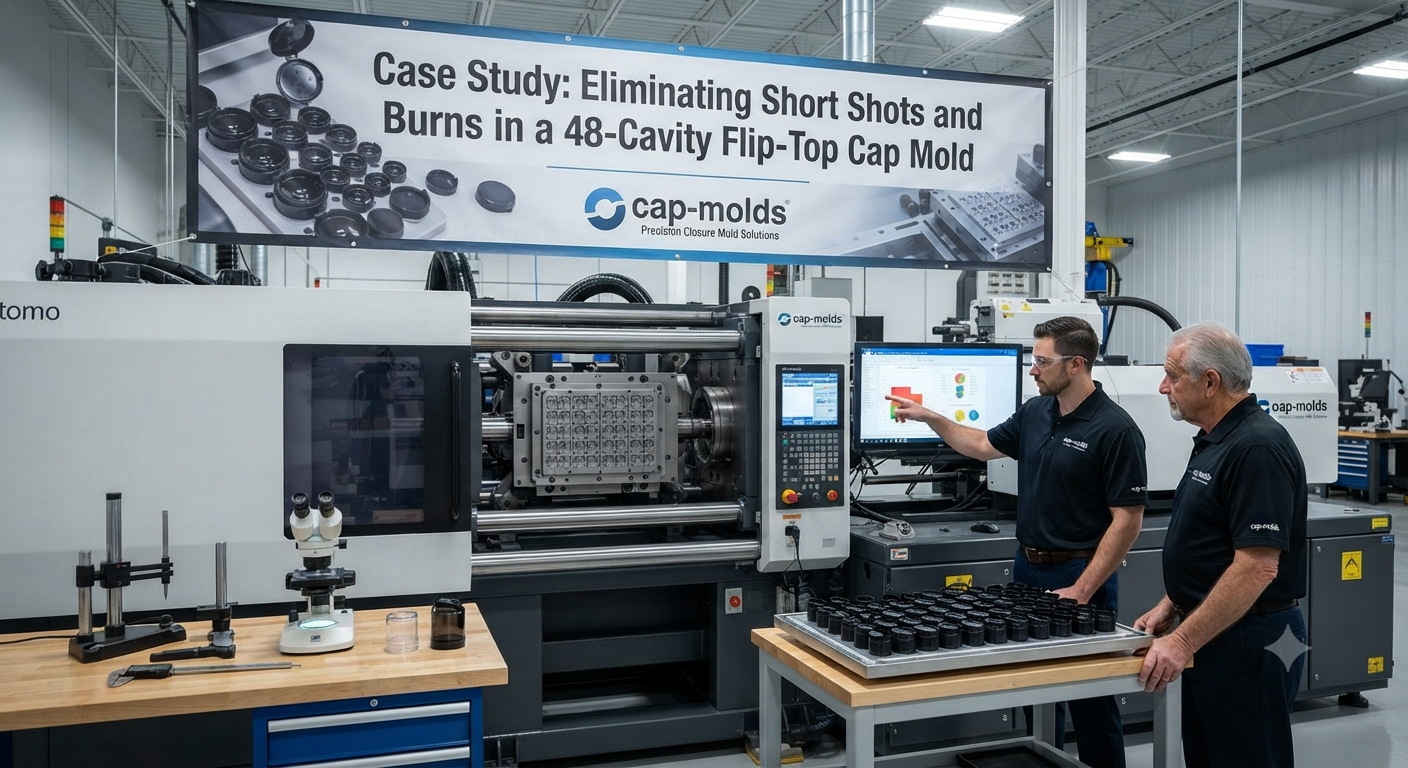
Case Study: Eliminating Short Shots and Burns in a 48-Cavity Flip-Top Cap Mold
In high-volume personal care and cosmetic packaging, flip-top caps represent one of the most mechanically demanding components to manufacture. Featuring intricate living hinges, snap-fit lips, and multi-part geometries, flip-top closures require absolute precision during the injection molding process. When scaling production to a high-cavity system—such as a 48-cavity mold—maintaining balanced melt flow, uniform thermal distribution, and pristine surface finishes becomes a complex engineering challenge.
This technical case study details how our engineering team at .cap-molds successfully diagnosed and resolved persistent short shots and localized burn marks in a 48-cavity flip-top cap mold for a global packaging client, transforming an unstable production line into a high-efficiency manufacturing asset.
1. Project Background and Initial Challenges
Our client, a major international packaging converter, approached .cap-molds after struggling with severe yield losses on an existing 48-cavity flip-top cap mold. The production run was plagued by two critical defects:
- Short Shots: Certain peripheral cavities consistently exhibited incomplete filling along the thin skirt and the outer edge of the flip-top lid, leading to structural failures and a rejection rate exceeding 12%.
- Burn Marks (Diesel Effect): Dark brown discoloration and polymer scorching appeared on the top dome and near the living hinge anchor points due to trapped air compression during high-speed injection.
These defects not only inflated raw material waste but also restricted machine operating speeds, driving up the overall unit cost (COGS).
2. Root Cause Analysis via Advanced Engineering Simulation
To pinpoint the exact mechanical and thermal failure points, the engineering team at .cap-molds initiated a comprehensive forensic review using advanced CAE Moldflow simulation software combined with physical dimensional scanning of the tooling.
A. Identifying Melt Imbalance in the Hot Runner Manifold
The simulation revealed that the legacy hot runner system suffered from non-uniform thermal and shear stress distribution. The outer cavities experienced an unwarranted temperature drop, increasing polymer viscosity and restricting flow velocity—the primary driver behind the short shots.
B. Gas Trapping and Inadequate Venting Architecture
Furthermore, the high-velocity resin flow front converged precisely at the thin living hinge section without providing adequate escape routes for displaced air. The trapped air compressed adiabatically, superheating to over 400°C and scorching the polypropylene (PP) resin, creating the signature burn marks.
3. The .cap-molds Engineering Intervention & Redesign
To permanently eradicate short shots and burns, .cap-molds engineered a comprehensive tool optimization and retrofitting strategy:
- Redesigned Manifold Architecture: We replaced the legacy hot runner manifold with a custom-engineered, naturally balanced hot runner system equipped with individual tip temperature controllers. This guaranteed that molten plastic reached all 48 cavities simultaneously and at identical thermal states.
- Micro-Venting Integration: We incorporated precision split-line venting inserts and vacuum-assisted air evacuation channels around the perimeter of the mold and the living hinge zones, completely eliminating gas compression and burning.
- Beryllium Copper (BeCu) Thermal Upgrades: To accelerate cooling around the thick hinge anchor zones, we embedded high-conductivity BeCu inserts, preventing localized hot spots and stabilizing the volumetric shrinkage rate.
- Material Upgrades: The core and cavity inserts were upgraded to premium Swedish S136 stainless steel hardened to HRC 48-52, ensuring high wear resistance and micro-inch surface finishes that minimized frictional melt drag.
4. Results and Performance Metrics
Following the implementation of the optimized 48-cavity mold design by .cap-molds, the production line achieved immediate, measurable improvements:
| Performance Metric | Before Optimization | After .cap-molds Intervention |
|---|---|---|
| Defect Rate (Short Shots & Burns) | 12.5% | < 0.3% |
| Cycle Time | 11.5 seconds | 8.2 seconds |
| Cavity Weight Variance | ± 1.8% | ± 0.2% (Absolute Uniformity) |
| Overall Equipment Effectiveness (OEE) | 68% | 94% |
5. Partner with .cap-molds for Expert Closure Solutions
This case study underscores why leading global packaging brands trust .cap-molds to solve their most complex tooling challenges. As a premier Chinese cap mold manufacturer, we combine rigorous DFM analysis, elite CNC machining (Makino and Yasda centers), and decades of specialized closure expertise to deliver turn-key mold solutions that maximize your productivity and profitability.
Facing persistent molding defects or looking to scale your production capacity? Contact the engineering experts at .cap-molds today to request a technical consultation and design review for your next bottle cap project.
Keywords: flip-top cap mold, 48 cavity cap mold, short shots in injection molding, burn marks plastic mold, .cap-molds, bottle cap mold, China cap mold manufacturer, hot runner optimization, living hinge mold design, injection molding defect troubleshooting, closure tooling expert, high cavitation mold, precision cap tooling, mold venting design