Future Trends in Cap Mold Technology: Tethered Caps, PCR Materials, and Smart Manufacturing
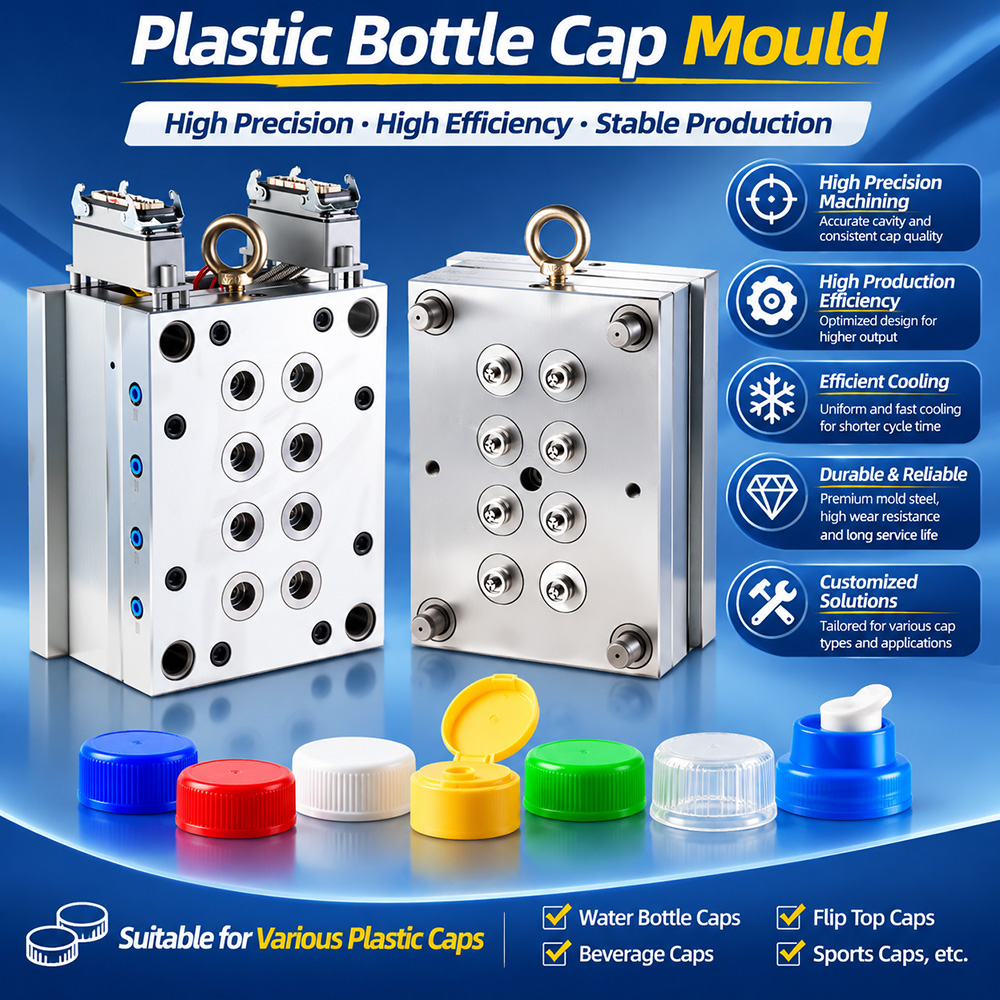
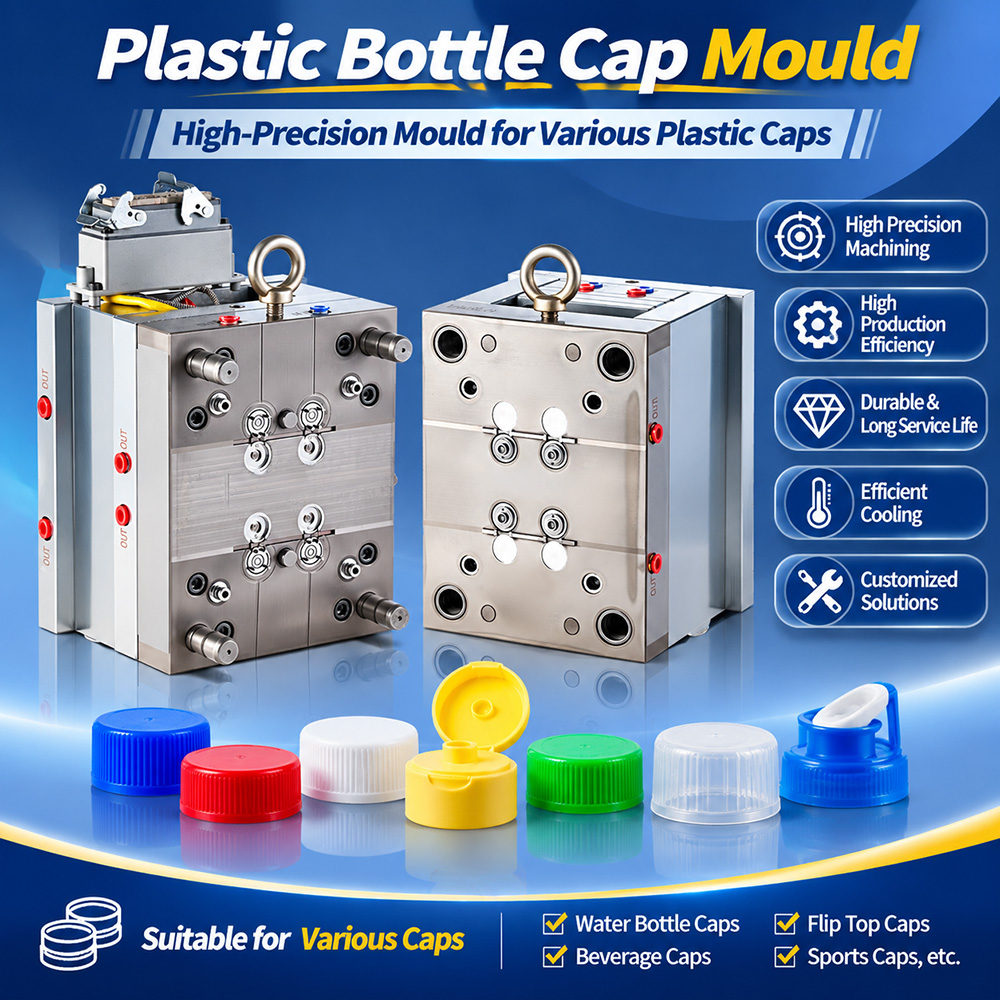
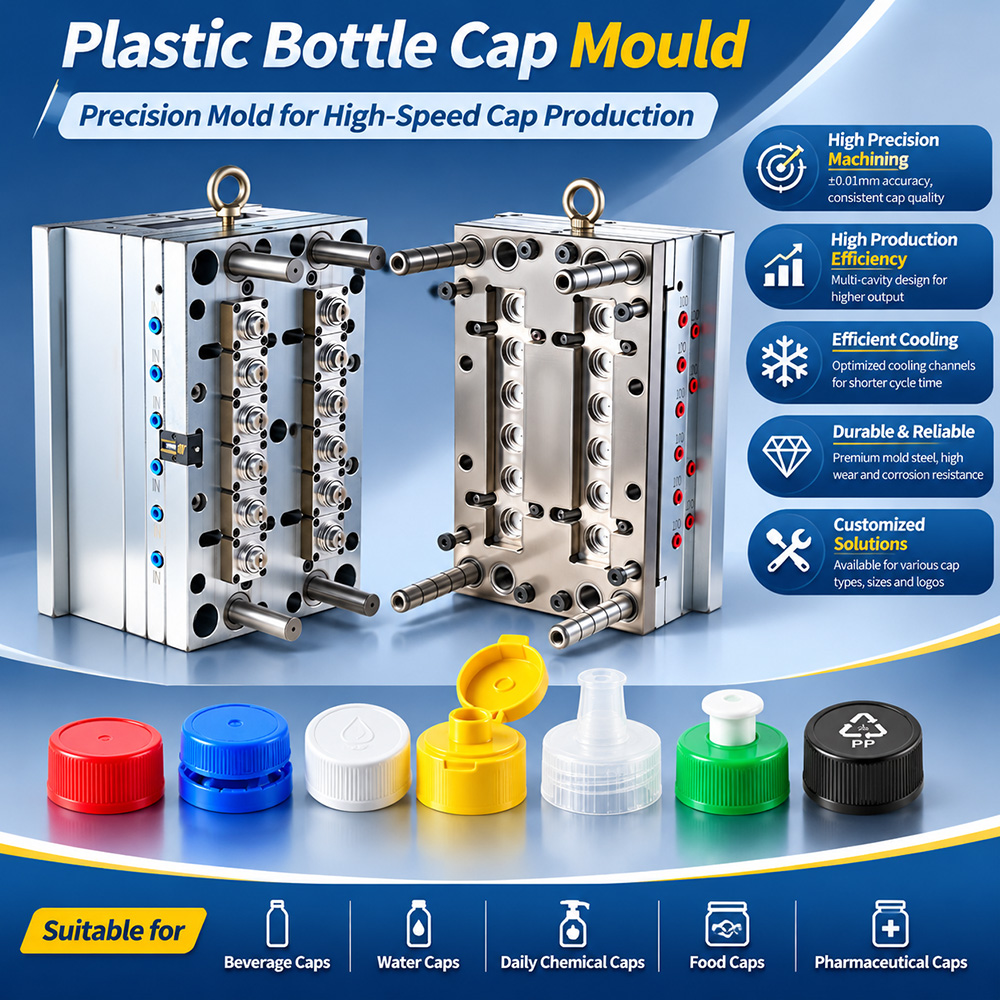
CAP-MOLDS manufactures precision bottle cap molds for the global packaging industry. The company’s product pages already document PCR-optimized hot runner architectures, tethered cap retrofit pathways, and smart tooling integration—because these are not future trends for us. They are active engineering requirements from customers shipping to European and North American markets.
This analysis examines each trend at the tooling level: what changes in the mold, why it matters, and what cap mold buyers should specify when ordering.
Trend 1: Tethered Caps Are a Mold Architecture Problem, Not a Cap Design Problem
The regulatory deadline has passed. The engineering consequences are still unfolding. EU Directive 2019/904 required that caps on single-use plastic beverage containers up to 3 liters remain attached to the bottle during intended use, enforced from July 2024 [citation:13]. The performance standard is concrete: the tether must withstand at least 25 N tensile force and survive at least 15 open-close cycles without functional loss [citation:2].
For mold makers, the challenge is not designing a cap that passes the pull test on day one. It is building a mold that produces that cap at high cavitation, at sub-4-second cycle times, with cavity-to-cavity consistency that survives millions of cycles.
What Changes Inside the Mold
The tethering mechanism dictates the modification scope. CAP-MOLDS’ retrofit analysis identifies three design pathways, each with different tooling implications [citation:7]:
| Tethering Approach | Mold Modification Scope | Production Risk |
|---|---|---|
| Double-cut tethering (slitting the tamper band while leaving a bridge intact) | Minimal mold change; modification focuses on downstream slitting station with shorter blade [citation:7] | Lowest tooling cost, but tether performance depends on bridge geometry and polymer ductility |
| Hinge-based tethering (film hinge connecting cap body to retention ring) | Slide height increases to ~15 mm; parting line moves upward; z-slides must be made taller without changing cavity pitch [citation:7] | Pitch constraint is critical—if taller slides encroach on inter-cavity space, a new mold base is required |
| Strap-based tethering (flexible strand connecting cap to retention band) | Neck ring inserts require complete replacement; cavity insert geometry changes for strap formation [citation:7] | Highest modification cost, but strap designs offer the most consumer-friendly opening experience |
The cooling challenge compounds the mechanical challenge. The tether hinge or strap represents a localized mass increase—thicker than the surrounding cap skirt. Without targeted cooling, this area produces sink marks, dimensional distortion, and incomplete crystallization that weakens the hinge [citation:7]. CAP-MOLDS addresses this through conformal cooling inserts produced by DMLS (direct metal laser sintering) that position cooling channels directly beneath the tether geometry, paired with beryllium copper core tips in deep thread sections.
Trend 2: PCR Materials Expose Every Weakness in Hot Runner and Cooling Design
Recycled HDPE and PP are not drop-in replacements for virgin resin. They arrive with broader molecular weight distributions, batch-to-batch melt flow index (MFI) variation, higher sensitivity to shear degradation, and trace abrasive contaminants [citation:3][citation:9]. A hot runner system optimized for stable virgin resin will produce inconsistent parts when the same mold runs PCR.
The Shear Problem: Why Standard Gate Diameters Fail with PCR
CAP-MOLDS’ technical analysis of PCR moldability identifies the core physics: shear rate at the gate wall is inversely proportional to the cube of the orifice radius. Restrictive gates designed for virgin polyolefins generate shear rates exceeding 12,000 s⁻¹ when processing PCR, breaking polymer chains and causing melt fracture, black specks, and gate stringing [citation:3].
| Tooling Parameter | Standard Virgin-Resin Design | CAP-MOLDS PCR-Optimized Architecture |
|---|---|---|
| Main manifold channel diameter | Ø 6.0–8.0 mm | Ø 9.5–12.0 mm (≈40% reduction in shear stress) |
| Gate orifice diameter | Ø 0.8–1.2 mm | Ø 1.5–2.0 mm with positive needle valve shut-off |
| Peak shear rate at gate | >12,000 s⁻¹ | Constrained below 4,500 s⁻¹ |
| Hydraulic pressure drop | 1,400–1,750 bar | 850–1,100 bar (≈30% lower injection pressure) |
Source: CAP-MOLDS PCR tooling engineering data [citation:3]
The larger gate does not extend cycle time because positive valve pin shut-off mechanically seals the orifice on fill completion, decoupling gate closure from thermal freeze-off. Conformal cooling around the gate bushing removes heat from the larger area rapidly enough to maintain sub-3.5-second cycles [citation:3].
Shrinkage and Contamination: The Less Visible Problems
PCR batches exhibit volumetric shrinkage variation that standard tooling tolerances cannot absorb. A mold machined to a fixed shrink rate of 1.022–1.025 for virgin HDPE will produce oval caps and loose threads when a PCR batch shrinks at 1.030 or 1.018 [citation:9]. CAP-MOLDS specifies customized shrink allowances based on the customer’s PCR supply profile, accepting a wider dimensional tolerance band in the tool while maintaining seal integrity through bore concentricity control.
Abrasive contamination—residual paper fibers, aluminum fragments, cross-polymer inclusions—accelerates wear on gate tips, core pins, and thread slides. PVD coatings (TiAlN, DLC) on core pins and replaceable tungsten carbide gate inserts extend component life beyond 5 million shots in PCR service, compared to uncoated tool steel that shows measurable gate enlargement within 1–2 million cycles [citation:9][citation:14].
Trend 3: Smart Manufacturing Has Become Table Stakes for High-Cavity Tools
“Smart mold” is an overused phrase, but the underlying capabilities are now practical requirements for competitive closure production. Three technologies have crossed the threshold from pilot projects to production-standard specifications.
Conformal Cooling: Cycle Time and Warpage Control
3D-printed conformal cooling channels that follow cavity contours reduce cycle times by up to 25% compared to conventional gun-drilled cooling, according to CAP-MOLDS’ technical documentation [citation:4]. For tethered caps with localized mass at the hinge, and for PCR caps with unpredictable shrinkage, conformal cooling provides thermal uniformity that conventional cooling cannot achieve. The investment is justified by cycle time reduction alone in high-cavitation molds; the quality benefit is additional.
In-Mold Pressure Telemetry: Scrap Reduction at the Source
Cavity pressure sensors detect short shots and flash before the mold opens, enabling real-time process adjustment or automatic part rejection. CAP-MOLDS designs mold plate architecture with native sensor mounting points, fiber-optic cable routing, and internal ports, so that telemetry can be added without post-hoc drilling or compromising mold integrity [citation:5]. For 64- and 96-cavity tools running PCR with variable MFI, cavity pressure feedback is the fastest path to stable scrap rates.
Sensor-Ready Mold Plates: Designing for Retrofit
The most practical smart manufacturing decision is not which sensors to install today, but whether the mold plate design accommodates sensors tomorrow. A mold ordered in 2026 will run for a decade. The production environment in 2031 will demand data that the mold specification should anticipate. CAP-MOLDS standardizes sensor mounting provisions on high-cavity closure molds, even when the initial order does not include telemetry hardware.
Integrating the Three Trends: A Specification Framework
A cap mold ordered today for a European beverage customer likely needs all three capabilities simultaneously: tethered geometry compliant with EN 17665:2022, PCR-compatible hot runner and metallurgy, and sensor-ready architecture. These are not independent decisions. The tether hinge cooling interacts with PCR shrinkage behavior. The larger gate orifice affects the pressure signature that telemetry monitors. The slide height increase for hinge tethering constrains conformal cooling routing.
CAP-MOLDS’ engineering process evaluates these interactions at the design stage, using mold flow simulation calibrated against the customer’s actual PCR supply and tethered cap functional requirements. The output is a tool specification that states, explicitly: the MFI range the hot runner is balanced for, the tether pull-force capability with the specified resin, the conformal cooling coverage in the hinge zone, and the sensor mounting provisions included.
Frequently Asked Questions
Can an existing standard cap mold be converted to produce tethered caps?
Yes, with caveats. Double-cut tethering requires minimal mold modification—primarily downstream slitting changes [citation:7]. Hinge-based designs require taller z-slides and revised parting lines, which is feasible if cavity pitch permits. Strap-based designs typically require neck ring replacement across all cavities [citation:7]. CAP-MOLDS evaluates retrofit feasibility based on the existing mold’s slide architecture, pitch, and cooling layout before recommending a pathway.
What is the minimum PCR content a mold should be designed to handle?
CAP-MOLDS recommends specifying PCR compatibility based on the maximum recycled content the plant realistically expects to run, not the current blend. A mold optimized for 30% PCR may require hot runner modification when the plant transitions to 50% or 100%. The shear-reduction and wear-resistance measures that support high PCR content do not penalize virgin resin processing—they simply widen the operating window.
Is conformal cooling necessary for tethered cap molds?
It depends on the tether design and cycle time target. Hinge-based tethering creates a localized thick section that benefits significantly from targeted cooling. Strap designs with thinner cross-sections may be manageable with optimized conventional cooling. CAP-MOLDS evaluates the thermal load of the specific tether geometry and recommends conformal inserts where the cycle time or quality benefit justifies the tooling cost.
How does CAP-MOLDS support customers transitioning from virgin to PCR resin?
CAP-MOLDS provides PCR-optimized tooling architecture including enlarged hot runner channels, positive valve gate shut-off, wear-resistant metallurgy, and customized shrinkage allowances. For customers with existing molds, we evaluate whether hot runner or gate modification can extend the tool’s PCR processing window, or whether a new tool is the more economical path.