Hot Runner vs Cold Runner for Cap Molds: Which System Saves More Cost and Material?
Hot Runner vs Cold Runner for Cap Molds: Which System Saves More Cost and Material?
In the high-speed world of plastic closure manufacturing, choosing the right runner system is one of the most critical financial and engineering decisions a packaging producer can make. Whether you are manufacturing 8,000 or 800,000 bottle caps per day, the choice between a hot runner system and a cold runner system directly dictates your raw material consumption, cycle times, unit costs (COGS), and overall operational profitability.
As a leading Chinese engineering and manufacturing specialist in high-performance closure tooling, .cap-molds designs and delivers optimized mold solutions tailored to exact volume and economic requirements. In this technical whitepaper, our engineering team breaks down the mechanics, economic tradeoffs, and material efficiency of hot runner versus cold runner architectures for plastic cap molds.
1. Fundamental Definitions: How Both Systems Operate
Before evaluating cost savings, it is essential to understand the structural differences between runner technologies in injection molding:
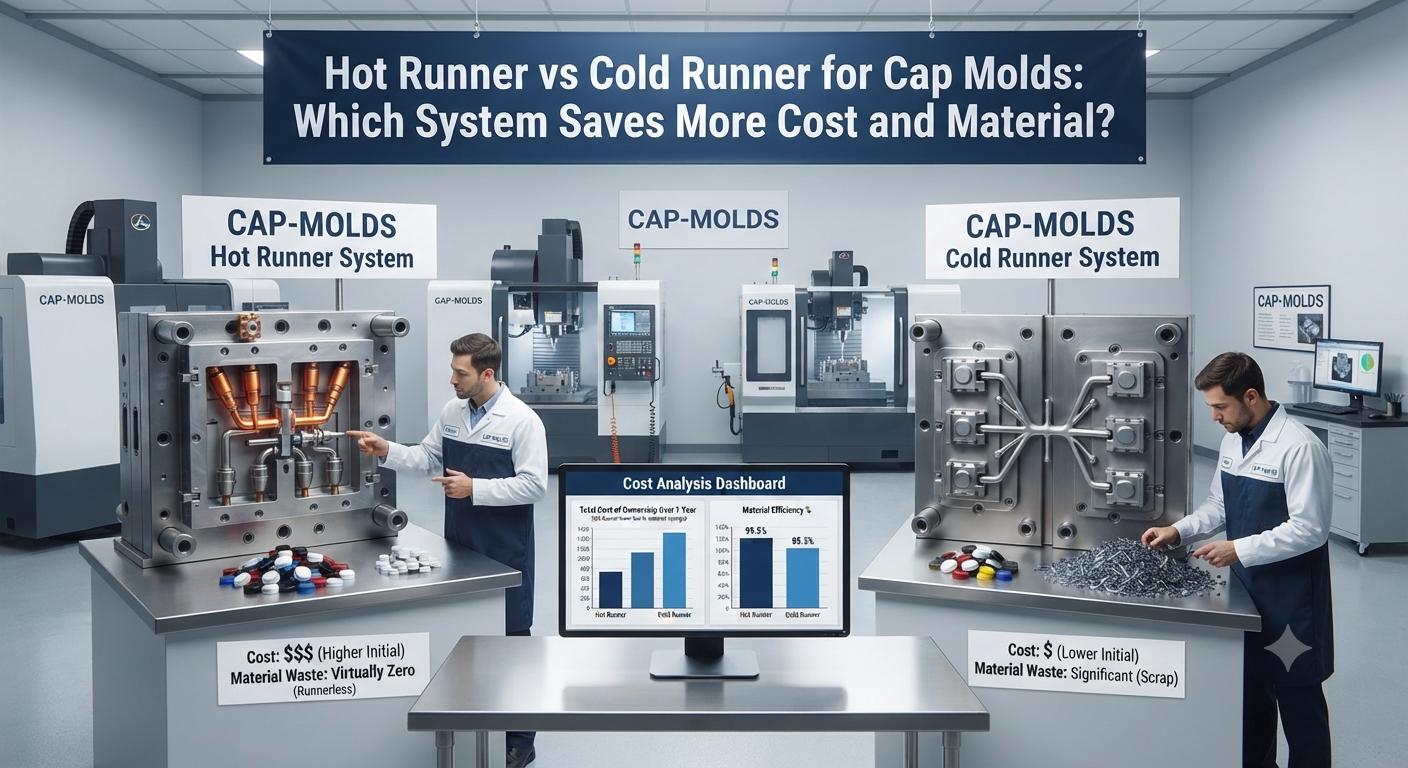
- Cold Runner Molds: In a cold runner configuration, the plastic melt is fed through a runner network that is maintained at the same ambient temperature as the mold base. The plastic inside the runner solidifies during every cycle and is ejected along with the finished bottle caps, requiring secondary recycling or regrinding.
- Hot Runner Molds: A hot runner system utilizes an internally heated manifold and heated nozzle tips to keep the polymer in a molten state continuously from the machine nozzle straight to the gate. Only the cap inside the cavity solidifies, eliminating runner waste entirely.
2. Material Waste and Resin Economics
The most immediate and quantifiable difference between the two systems lies in material consumption and scrap generation.
- The Cold Runner Penalty: In high-cavity cold runner cap molds, runner weight can often account for 20% to 40% of the total shot weight. While regrinding and mixing regrind with virgin resin is common, high regrind percentages can degrade physical properties, trigger color inconsistency, and compromise the structural integrity of thin living hinges or snap-fit lips.
- The Hot Runner Advantage: By maintaining zero runner waste, .cap-molds hot runner systems ensure that 100% of injected polymer goes directly into revenue-generating bottle caps. For high-volume production lines running expensive engineering resins (such as specialized PP or HDPE formulations), the elimination of runner waste translates into massive annual raw material savings.
3. Cycle Time and Productivity Comparison
Cycle time dictates the maximum theoretical output of an injection molding cell.
- Cooling Constraints in Cold Runners: Because cold runner channels are thick relative to the thin walls of a bottle cap, the thick runner sections require significantly longer cooling times before the mold can open. This bottleneck artificially restricts machine speed.
- Unrestricted High-Speed Cycling: Hot runner systems remove the runner from the cooling equation. Molds engineered by .cap-molds can achieve ultra-fast cycle times (frequently under 6 to 8 seconds depending on cavitation), maximizing machine throughput and Overall Equipment Effectiveness (OEE).
4. Upfront Investment vs. Long-Term Return on Investment (ROI)
When reviewing capital expenditure (CapEx), project managers often face a complex trade-off:
- Initial Tooling Cost: Cold runner molds feature a simpler mechanical architecture, making them more affordable for low-volume pilot projects or short regional runs. Hot runner molds require sophisticated manifolds, independent temperature controllers, and precision machining, representing a higher initial investment.
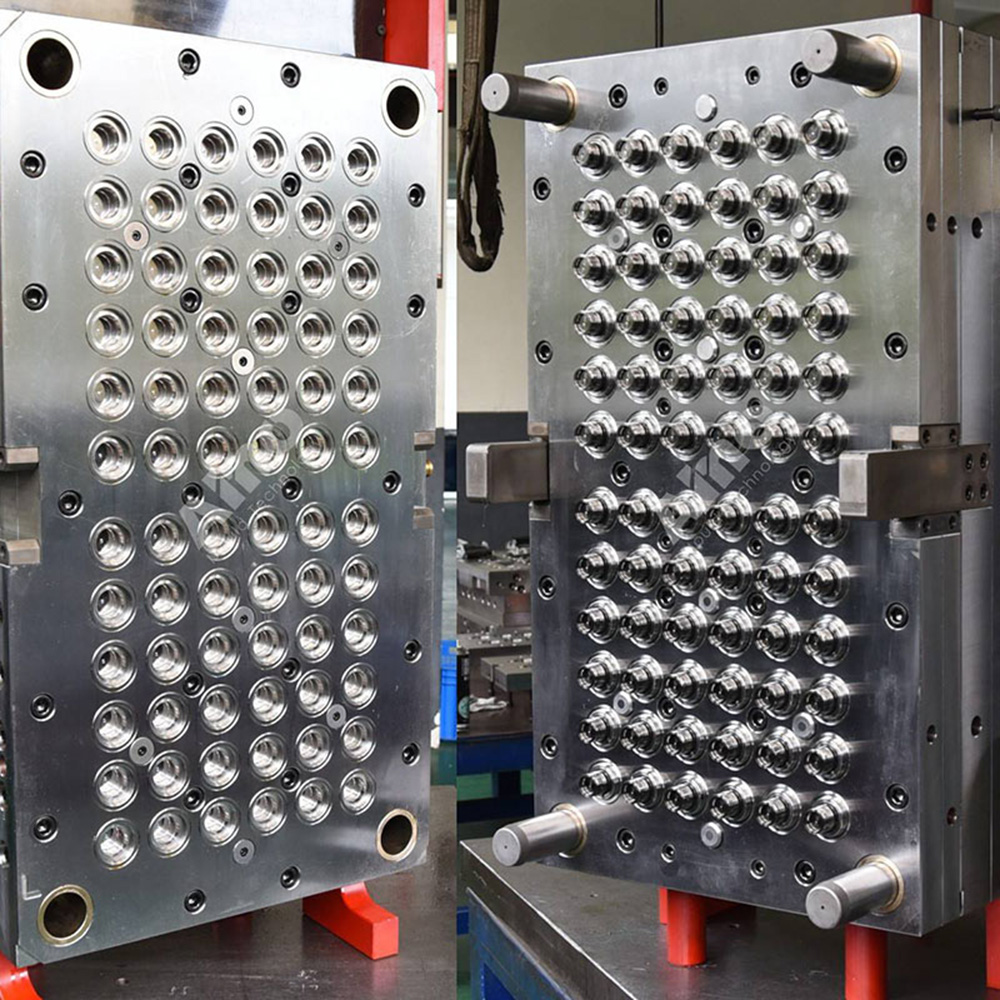
- Long-Term ROI: For mid-to-high volume production (such as 32-cavity, 48-cavity, or 64-cavity systems), the material savings, labor reduction (no manual runner separation), and energy efficiency of a hot runner mold typically deliver a full return on investment within 6 to 12 months.
5. Technical Comparison: Hot Runner vs. Cold Runner Cap Molds
| Evaluation Parameter | Cold Runner Cap Mold | Hot Runner Cap Mold |
|---|---|---|
| Initial Tooling Investment | Lower initial cost | Higher initial capital investment |
| Runner Material Waste | High (Requires separation and regrinding) | Zero waste (Direct gate injection) |
| Cycle Time Efficiency | Slower (Limited by thick runner cooling time) | Ultra-fast (Optimized for high-speed output) |
| Ideal Production Volume | Low-to-medium volume, custom prototypes | High-volume mass production (32+ cavities) |
Partner with .cap-molds for Custom Closure Solutions
Selecting between a hot runner and a cold runner system depends entirely on your production volume, budget constraints, and quality standards. As a premier Chinese cap mold manufacturer, .cap-molds provides expert engineering consultations, rigorous DFM analysis, and custom-built tooling designed to maximize your profitability.
Unsure which runner system best suits your upcoming packaging project? Contact the engineering experts at .cap-molds today to receive a comprehensive technical proposal and cost-benefit analysis.
Keywords: hot runner vs cold runner, bottle cap mold, cap mold design, .cap-molds, hot runner system, China cap mold manufacturer, injection molding efficiency, plastic closure tooling, high cavitation mold, reduce material waste, injection molding ROI, high speed cap production, precision cap tooling, mold runner comparison