Managing Cap Flash: Root Causes, Prevention Strategies, and Process Optimization
Managing Cap Flash: Root Causes, Prevention Strategies, and Process Optimization
Published by cap-molds — Leading China Bottle Cap Mold Manufacturer & Precision Closure Tooling Solutions Authority
1. Introduction: The Challenge of Cap Flash in High-Speed Closure Molding
In high-speed, multi-cavity injection molding of plastic closures, flash formation remains one of the most persistent defect types affecting product quality and manufacturing profitability. Cap flash occurs when molten polymer escapes the intended mold cavity and seeps between parting lines, core pins, stripper rings, or ejector interfaces. Left unaddressed, micro-flash can compromise seal integrity, obstruct tamper-evident bands, interfere with capping line sorting equipment, and accelerate tool wear.
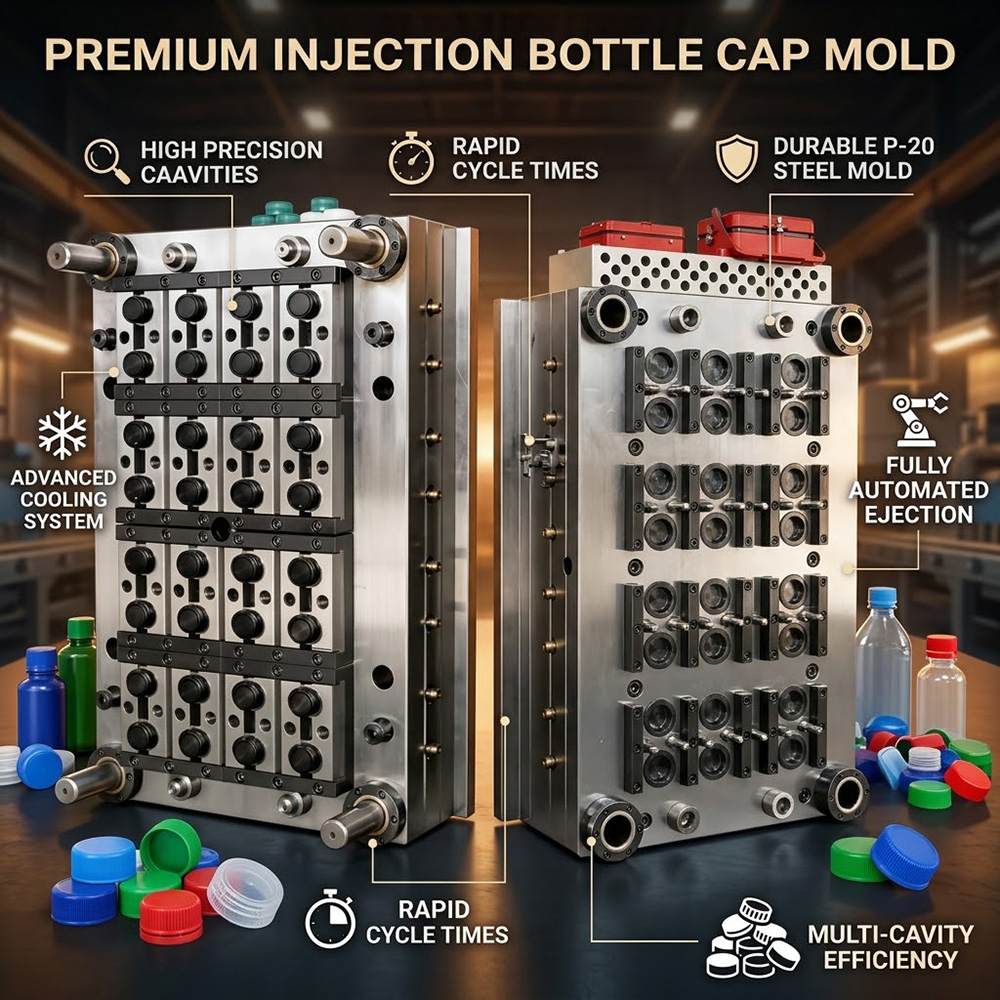
For global beverage and packaging converters, eliminating cap flash without sacrificing rapid cycle times requires an integrated understanding of mold design, thermal rheology, and press kinematics. As a premier bottle cap mold manufacturer in China, cap-molds engineers specialized closure tooling systems designed to mitigate flash through ultra-precise machining tolerances, dynamic thermal balancing, and structural rigidity.
2. Root Causes of Flash in Injection Molded Closures
Achieving flash-free cap production requires systematic diagnosis across three key vectors: machine processing parameters, polymer behavior, and mold tool architecture.
Key Factors Driving Cap Flash:
- Insufficient Clamping Force or Platen Deflection: Excessive injection pressure during peak packing phases can overpower press tonnage or cause center-platen deflection, causing microscopic parting line separation.
- Thermal Imbalance & Melt Rheology: Overheated resins experience severe viscosity drops, enabling low-viscosity polymer melts to penetrate gaps as narrow as 0.005mm to 0.01mm along parting lines.
- Tooling Deflection & Machining Wear: Microscopic hobbing, thermal expansion variance between core inserts and cavity plates, or improper pre-load on core pins creates unintended parting line gaps.
- Unbalanced Hot Runner Systems: Cavity-to-cavity filling variation leads to localized over-packing in faster-filling drops, forcing open specific cavities while others are still filling.
3. Tooling Engineering Strategies to Eliminate Cap Flash
At cap-molds, our engineering philosophy focuses on preventative tool design, ensuring long-term parting line integrity even under aggressive continuous multi-million cycle operations.
| Root Cause Vector | Standard Tooling Approach | cap-molds Precision Engineering Solution |
|---|---|---|
| Parting Line Wear | Standard steel grades (e.g., P20) | Premium hardened stainless steel (S136 / Stavax ESR, HRC 52-54) with corrosion and wear resistance |
| Melt Distribution | Standard open-nozzle hot runners | Direct needle valve gate hot runners featuring individual cavity temperature loops (±0.3°C accuracy) |
| Plate Deflection | Standard plate thickness calculation | FEA-optimized heavy-duty mold base construction preventing core and cavity plate flexure under high tonnage |
| Ejection Interface Sealing | Conventional sliding fit stripper rings | Guided stripper plate mechanics with micro-taper sealing land geometry for flash-free stripping |
4. Processing Optimization & Pressure-Temperature-Volume (PVT) Control
Eliminating flash requires decoupling peak filling pressure from holding pressure. Processing engineers utilizing cap-molds tooling benefit from wide processing windows engineered directly into our mold cavity dimensions.
- Decoupled Molding Setup: Transition from high-speed velocity-controlled filling to pressure-controlled packing at 95-98% volumetric fill to prevent hydrostatic pressure spikes.
- Optimal Clamp Tonnage Calibration: Calculate minimum required clamping force based on projected cavity surface area while maintaining a 10-15% safety buffer to protect mold parting surfaces.
- Melt Temperature Balancing: Maintain uniform resin melt viscosity across all cavities to prevent flash caused by localized thermal hot spots.
5. Maintenance and Parting Line Protection Protocols
Long-term flash prevention relies heavily on rigorous mold maintenance protocols. Continuous production of HDPE and PP closures generates micro-deposits of resin off-gassing, which can accumulate on venting channels and force parting lines open if left uncleaned.
cap-molds integrates self-cleaning micro-venting features (0.015mm vent depth) engineered to purge gases efficiently while preventing resin ingress. Regular ultrasonic cleaning of cavity inserts and routine inspection of shut-off angles ensure maximum operational lifespan and zero flash defect rates.
Partner with cap-molds for Precision Closure Tooling
Whether you are producing lightweight CSD closures, water bottle caps, edible oil caps, or complex tethered closures, cap-molds provides end-to-end tooling expertise. By integrating advanced European tool steel selection, precision valve gate hot runners, and state-of-the-art CAD/CAE simulation, we deliver high-cavitation cap molds built for maximum uptime and zero-defect quality.