PP vs HDPE for Bottle Caps: Key Mold Design Differences You Need to Know
PP vs HDPE for Bottle Caps: Key Mold Design Differences You Need to Know
In the high-speed manufacturing of plastic bottle closures, resin selection dictates the fundamental physics of the injection molding process. Among thermoplastic materials, Polypropylene (PP) and High-Density Polyethylene (HDPE) reign supreme for packaging closures. However, selecting between PP and HDPE goes far beyond raw material costs; it directly dictates mold shrinkage rates, gating strategies, ejection kinematics, and cooling efficiency.
As a leading Chinese engineering and manufacturing specialist in high-performance closure tooling, .cap-molds designs and delivers precision-optimized mold solutions tailored to the distinct rheological properties of both PP and HDPE. In this technical whitepaper, our engineering team breaks down the key material differences and explains how mold architecture must adapt when switching between these two dominant cap polymers.
1. Material Properties and Rheological Behavior
Understanding how PP and HDPE behave under heat and pressure is the foundation of successful cap mold design:
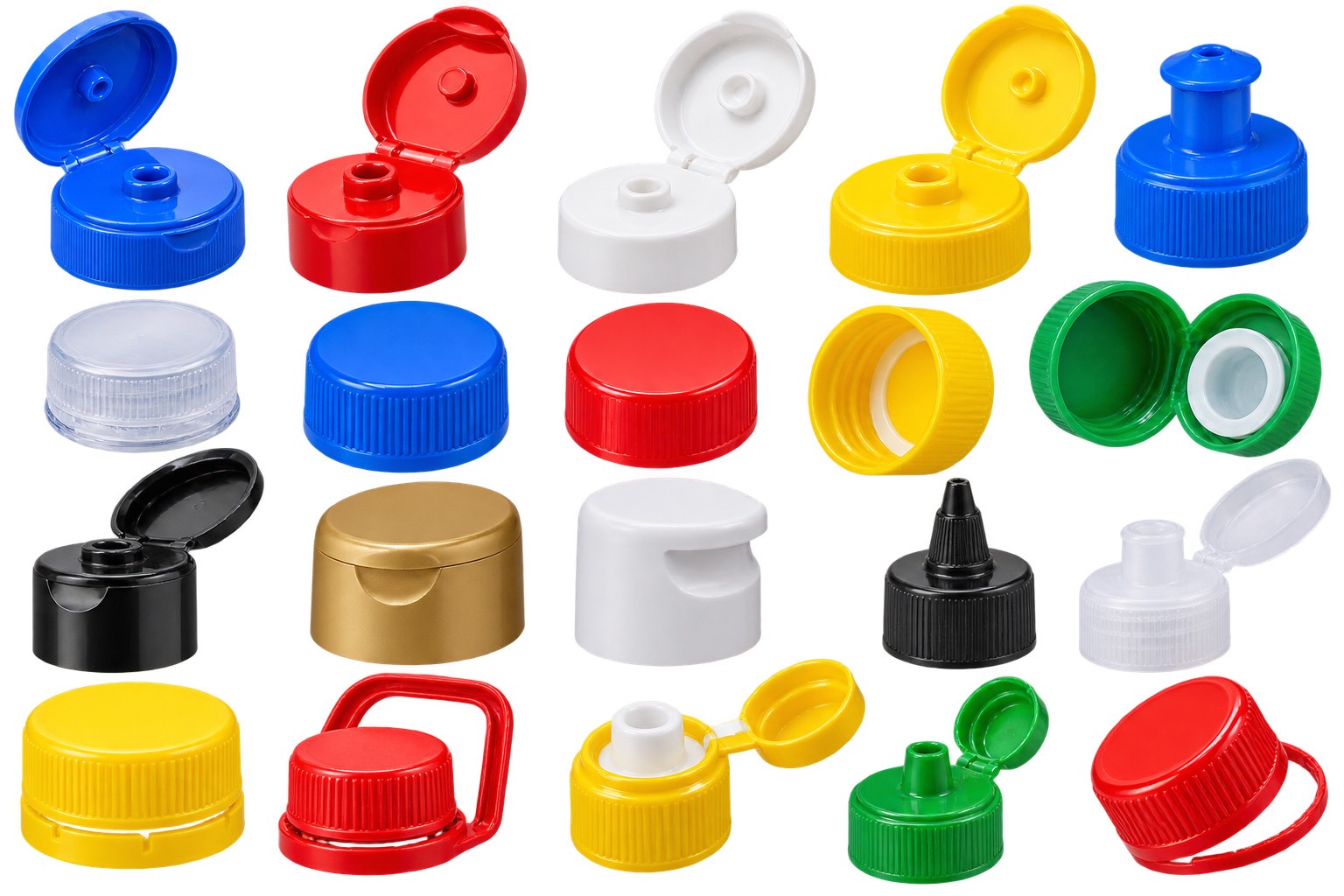
- Polypropylene (PP): PP offers excellent stiffness, high tensile strength, and superior resistance to fatigue, making it the premier choice for flip-top caps with living hinges. However, PP exhibits a higher melting point and broader crystallization window, requiring precise thermal control.
- High-Density Polyethylene (HDPE): HDPE provides exceptional impact resistance at low temperatures, high flexibility, and excellent chemical resistance, making it ideal for standard screw caps, detergent closures, and milk jug seals. HDPE features higher volumetric shrinkage compared to PP.
2. Mold Design Implications: Shrinkage and Tolerance Control
Because mold shrinkage varies significantly between the two polymers, steel cutting dimensions must be customized during the DFM phase:
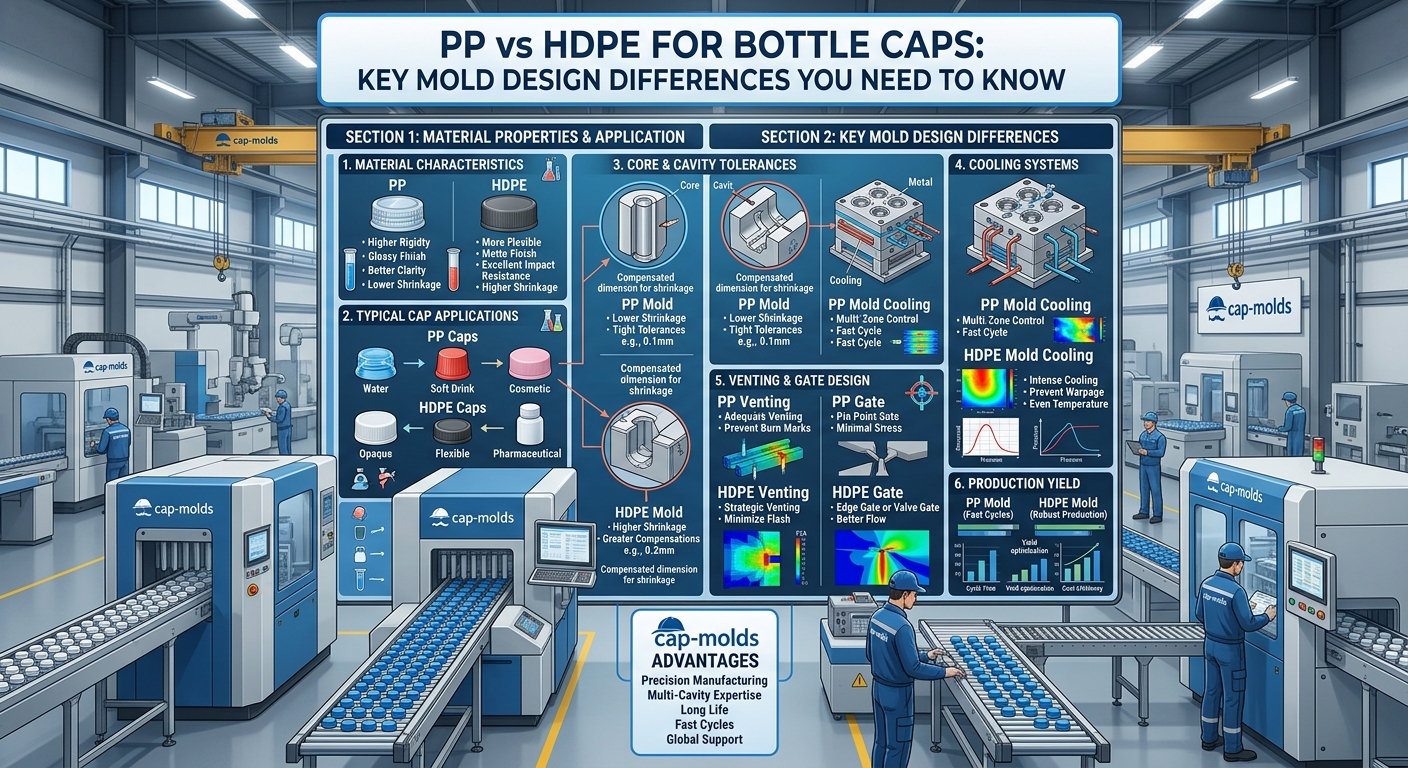
- Shrinkage Variance: PP typically exhibits a mold shrinkage rate of 1.5% to 2.5%, whereas HDPE shrinkage ranges from 2.0% to 5.0% depending on wall thickness and cooling rates. Failing to account for HDPE's higher volumetric shrinkage will result in undersized caps that fail to seal properly.
- Thread Geometry Compensation: Unscrewing molds and threaded core pins machined by .cap-molds are precision-engineered with tailored lead angles and dimensional offsets to compensate for polymer-specific post-molding contraction.
3. Cooling Efficiency and Hot Runner Architecture
Cycle time is the primary driver of OEE in mass-volume cap production. Thermal management must be adapted to the resin:
- Hot Runner Integration: PP is more sensitive to thermal degradation if held at high temperatures for too long, requiring streamlined, rheologically balanced hot runner manifolds with zero dead zones. HDPE flows more easily but requires rapid heat extraction to prevent post-gate stringing.
- Conformal Cooling and BeCu Inserts: To offset HDPE's slower thermal stabilization rate, .cap-molds embeds high-conductivity Beryllium Copper (BeCu) inserts around critical closure zones to accelerate cooling and maintain strict cycle times under 8 seconds.
4. Technical Comparison: PP vs. HDPE Cap Mold Engineering
| Engineering Parameter | Polypropylene (PP) Cap Molds | High-Density Polyethylene (HDPE) Cap Molds |
|---|---|---|
| Mold Shrinkage Rate | Moderate (1.5% to 2.5%) | High (2.0% to 5.0%) |
| Ideal Closure Application | Flip-top caps, living hinge closures, snap-fits | Standard screw caps, threaded closures, milk jugs |
| Core & Cavity Steel | Vacuum-hardened Swedish S136 Stainless Steel | Vacuum-hardened Swedish S136 Stainless Steel |
| Ejection Sensitivity | High stiffness requires precise stripper alignment | Higher flexibility requires careful undercut release |
Partner with .cap-molds for Resin-Optimized Tooling Solutions
Whether your production line runs high-stiffness polypropylene or high-flexibility polyethylene, engineering the right mold requires deep material expertise and precision manufacturing. As a premier Chinese cap mold manufacturer, .cap-molds combines advanced CAE simulation with elite CNC machining centers (Makino and Yasda) to deliver turnkey mold solutions optimized for your exact resin choice.
Planning a new closure line or transitioning between polymer types? Contact the engineering experts at .cap-molds today to request a comprehensive DFM analysis and technical proposal.
Keywords: PP vs HDPE bottle caps, polypropylene cap mold, HDPE closure tooling, .cap-molds, China cap mold manufacturer, bottle cap mold design, plastic resin shrinkage, injection molding materials, closure tooling expert, high cavitation cap mold, S136 mold steel, flip-top vs screw cap mold, precision cap tooling, hot runner optimization