Processing rHDPE and rPP in High-Cavity Cap Molds: Challenges in Melt Flow Index Variation and Contamination Control
Processing rHDPE and rPP in High-Cavity Cap Molds: Challenges in Melt Flow Index Variation and Contamination Control
Published by cap-molds — Technical Whitepaper & Engineering Guide
Introduction: The Circular Economy Shift in Closure Tooling
Driven by global sustainability targets, regulatory packaging mandates, and extended producer responsibility (EPR) frameworks, rigid packaging molders are rapidly increasing the incorporation of post-consumer recycled resin (PCR)—specifically recycled High-Density Polyethylene (rHDPE) and recycled Polypropylene (rPP)—into closure production lines. While switching from virgin resin to PCR reduces carbon footprint, it introduces severe mechanical, thermal, and rheological processing challenges in multi-cavity injection tooling.
Unlike virgin polymers with highly stable material specifications, recycled resins exhibit significant batch-to-batch Melt Flow Index (MFI) variations, variable shear sensitivity, and residual solid micro-contaminants. As a specialized China bottle cap mold manufacturer, cap-molds engineers robust high-cavitation closure tools equipped with adaptive thermal control, specialized filtration hot runners, and wear-resistant tool steel to maintain maximum production efficiency when processing rHDPE and rPP blends.
1. Mitigating Melt Flow Index (MFI) Fluctuation Across High-Cavitation Tools
MFI variability in recycled feedstocks leads to unbalanced cavity filling, inconsistent cap weight, localized flash, and short shots—especially in 32, 48, or 64-cavity mold configurations. Small shifts in viscosity disrupt injection pressure distribution across the runner manifold.
Engineering Solutions for Viscosity Variations:
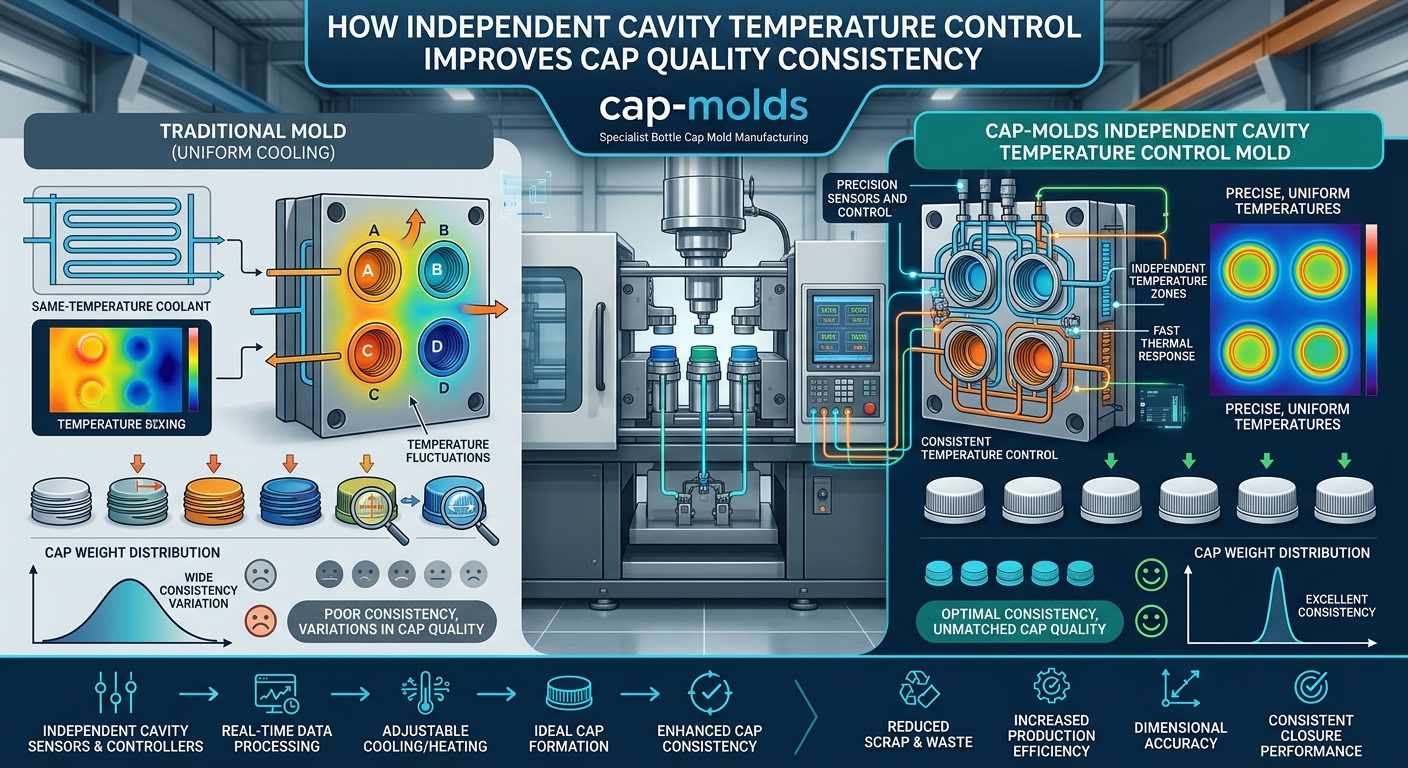
- Individual Zone Thermal Compensation: Integrating independently controlled PID heating zones along each hot runner nozzle tip allows operators to make fine micro-temperature adjustments, offsetting viscosity spikes across specific cavity clusters.
- Rheologically Balanced Runner Manifolds: Utilizing symmetrical, naturally balanced hot runner channels designed via Moldflow rheological software ensures equal shear rate distribution to every gate, minimizing fill imbalance caused by MFI drift.
- Dynamic Valve-Gate Timing: Pneumatically or hydraulically actuated valve-gate systems with sequential pin timing prevent melt hesitation in thin-wall cap features when lower-MFI recycled batches are introduced.
2. Contamination Control and Advanced Melt Filtration Integration
Post-consumer rHDPE and rPP feedstocks frequently contain trace contaminants such as cross-polymer inclusions, degraded carbon specs, metallic micro-particles, and residual labels. In high-precision cap tooling where core pin clearances and gate diameters are measured in sub-millimeters, un-filtered particulate causes gate clogging and premature mold wear.
| Contamination Type | Impact on Tooling & Quality | cap-molds Tooling Mitigation Strategy | Operational Result |
|---|---|---|---|
| Polymer Degraded Specs & Gels | Gate blockage; pin vestige defect; cosmetic flaws | Integrated filter nozzle tips & edge-gate filtration gaps | Prevents gate orifice blockage; ensures smooth ejection |
| Abrasive Solid Particulates | Rapid gate erosion; micro-flashing at split lines | Powder metallurgy inserts (CPM 10V / Vanadis 4 Extra) | Extends gate tip and shut-off area lifespan beyond 5 million shots |
| Volatile Off-Gassing & Acids | Vent clogging; surface corrosion; void formation | Expanded micro-venting channels (0.015 mm) with PVD coating | Eliminates diesel effect burn marks; facilitates rapid gas evacuation |
3. Metallurgical Selection and Wear-Resistant Coatings
Recycled HDPE and PP resins often carry fine abrasive particulates (such as mineral fillers or residual washed flakes) that accelerate mechanical wear on core pins, thread slides, and stripper plates. At cap-molds, we enforce advanced tribological and metallurgical standards to ensure tool longevity.
- Corrosion and Wear-Resistant Steels: Cavity and core inserts are crafted from high-chromium stainless steels (such as S136, Stavax, or 1.2083) hardened to HRC 50–54 to withstand corrosive volatiles released during PCR processing.
- Specialized PVD & DLC Surface Coatings: Physical Vapor Deposition (PVD) and Diamond-Like Carbon (DLC) coatings applied to ejector sleeves and core pins reduce sliding friction coefficients below 0.1, eliminating the need for external liquid lubricants that could contaminate recycled caps.
- Tungsten Carbide / BeCu Gate Inserts: Utilizing replaceable tungsten carbide or high-hardness Beryllium Copper inserts around the injection point prevents gate enlargement caused by continuous abrasive melt flow.
4. Conformal Cooling and Warpage Prevention in Recycled Caps
Recycled HDPE and PP exhibit different crystallization behavior and shrinkage rates compared to virgin polymers. Uneven thermal dissipation across deep cap cores causes out-of-roundness, thread distortion, and compromised seal lip geometry.
To preserve structural cap integrity and maintain fast cycle times under 6 seconds, cap-molds integrates advanced cooling technologies:
- 3D-Printed Conformal Cooling Cores: Direct Metal Laser Sintering (DMLS) creates internal fluid channels that follow the exact contours of the cap thread profile, ensuring uniform heat extraction.
- Optimized Core Thermal Dissipation: High thermal conductivity inserts pull heat rapidly from localized thick sections, reducing differential shrinkage and warpage across all cavities.
- Interchangeable Thread Cores: Sub-micron machining accuracy allows quick swapping of core inserts calibrated for varying shrinkage ratios depending on the percentage of PCR content (e.g., 30%, 50%, or 100% rHDPE).
5. Quality Validation and Factory Acceptance Testing (FAT)
Validating a high-cavitation cap mold for recycled resin processing requires testing under real-world factory conditions using actual client PCR feedstocks prior to mold shipment.
Our Quality Audit Protocol Includes:
- Multi-MFI Trial Runs: Conducting continuous T1 injection trials using high- and low-MFI rHDPE/rPP batches to test gate response and filling consistency.
- CMM & Optical Dimensional Audits: Measuring key dimensions across all cavities to verify plug seal, thread pitch, and tamper-evident band integrity.
- Seal Integrity & Torque Testing: Subjecting produced rHDPE caps to leak testing, strip torque tests, and drop testing to confirm functional parity with virgin resin closures.
Partnering with cap-molds for Sustainable Closure Tooling Solutions
At cap-molds, we are committed to advancing sustainable rigid packaging through precision mold engineering. Whether processing virgin resins, light-weighted closures, or high-percentage rHDPE/rPP PCR blends, our custom tooling solutions deliver uncompromised speed, high-cavitation consistency, and long operational lifespans.
By integrating advanced melt filtration, conformal cooling, and wear-resistant metallurgy, cap-molds helps global packaging converters transition to sustainable materials while maintaining peak plant productivity and profitability.