Tethered Cap Mold Engineering: Design Principles, Kinematic Requirements, and EU Regulatory Compliance
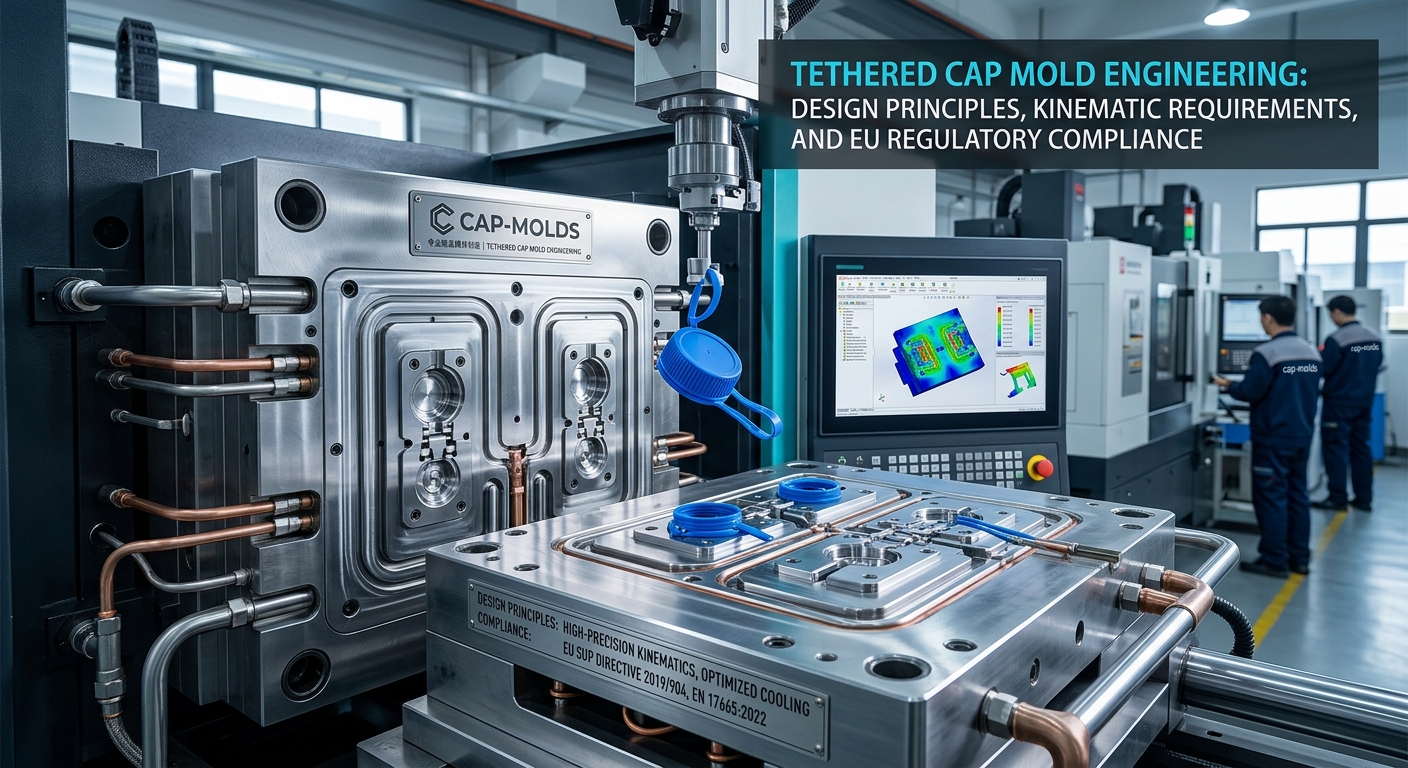
Tethered Cap Mold Engineering: Design Principles, Kinematic Requirements, and EU Regulatory Compliance
Published by cap-molds — Technical Whitepaper & Engineering Guide
Introduction & Regulatory Mandate
The global rigid packaging industry is undergoing a structural transition driven by environmental policy and sustainable polymer engineering. Foremost among these mandates is the European Union Single-Use Plastics (SUP) Directive (Directive EU 2019/904), specifically Article 6, which mandates that beverage containers up to three liters equipped with plastic caps and lids must remain attached to the container during the product's intended use stage.
Achieving compliance under standards such as EN 17665:2022 (Packaging - Test methods and requirements to demonstrate that plastic caps and lids remain attached to beverage containers) presents complex mechanical and processing challenges. For closure manufacturers, compliant tethered closures require precise kinematic performance: the tether must withstand a minimum tactile pull force of 25 N, maintain an opening angle greater than 120 degrees without snap-back, and allow millions of high-speed capping cycles without mechanical failure.
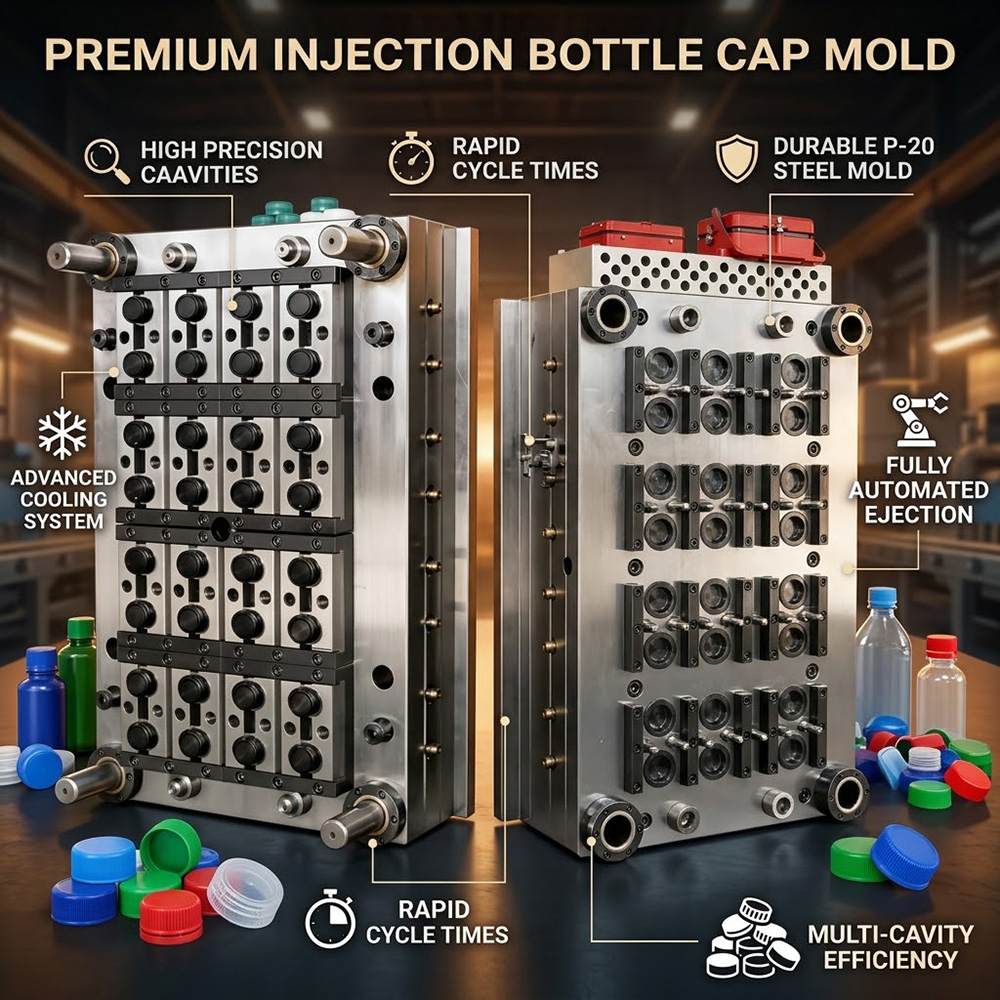
As a premier high-precision closure tooling specialist in China, cap-molds designs and builds advanced tethered cap molds engineered for ultra-fast cycle times, absolute multi-cavity interchangeability, and strict adherence to global regulatory standards.
1. Kinematic Requirements and Hinge Geometry Engineering
Designing a compliant tethered closure requires balancing resin elasticity, mold ejection mechanics, and consumer usability. Unlike traditional detachable caps, tethered caps incorporate functional hinges, tether straps, or dual-band retaining mechanisms directly into the closure architecture.
Key Kinematic Criteria:
- Retention Strength (EN 17665 Compliance): The tether joint and retaining ring must maintain mechanical integrity under tensile loads exceeding 25 N to 30 N to prevent accidental detachment during consumer use and recycling collection.
- Ergonomic Clearance & Opening Angle: Hinge mechanisms must feature bi-stable or active latch geometries that hold the cap back at an angle of 120° to 180° away from the bottle neck finish, preventing obstruction during pouring or drinking.
- Thread Engagement & Capping Torque: Tether straps cannot interfere with high-speed capping machinery or create rotational drag, which could lead to skewed thread engagement or improper seal torque.
2. Advanced Tethered Cap Mold Tooling Architectures
Tooling for tethered caps requires complex split line configurations, slide mechanisms, and specialized ejection sequences to form intricate tether bridges, living hinges, and retention bands without extending cycle times.
| Tether Concept Type | Tooling Mechanism | Key Mold Engineering Challenge | Primary Benefit |
|---|---|---|---|
| Integrated Living Hinge | Active slide cores with high-precision core pin shut-offs | Preventing micro-flashing while maintaining thin hinge web thickness (0.25mm - 0.35mm) | One-piece execution, zero post-mold slitting required |
| Slitted / Slit-Folded Tether Band | Standard injection mold combined with high-speed rotary slitting machine | Controlling knife bridge width and thermal stress on retaining bridges | Allows retrofit of existing neck finishes with lower upfront mold complexity |
| Lasso / Double-Ring Tether | Complex lifter systems & multi-stage mechanical stripping plates | Ensuring uniform ejection of extended lower strap without tearing or permanent deformation | Maximum freedom of motion and optimal consumer pouring ergonomics |
3. Steel Metallurgy, Thermal Dissipation, and Hot Runner Integration
High-cavitation tethered cap tooling operates under high injection pressures and elevated thermal cycles. At cap-molds, we enforce rigorous metallurgical standards to guarantee mold service lifespans exceeding 5 to 10 million cycles.
- Mold Cavity & Core Steels: Premium Swedish and German stainless steels (S136, Assab 8407, or ESR-grade 1.2083) hardened to HRC 50–54 provide exceptional wear resistance against abrasive HDPE/PP resins and additive masterbatches.
- Conformal Cooling Inserts: Utilizing 3D metal printed (SLM) core inserts with conformal cooling lines allows liquid coolant to flow within millimeters of the core tip and hinge geometry. This minimizes localized heat buildup and reduces total cooling time by up to 25%.
- Valve-Gated Hot Runner Systems: Specialized valve-gate hot runners deliver balanced melt distribution to every individual cavity with zero gate vestige, ensuring stable pressure transmission essential for delicate tether bridge filling.
4. Moldflow Analysis and Micro-Injection Balance
Because tether straps and hinge webbing feature wall thicknesses significantly thinner than the main cap shell, non-uniform melt fronts can cause air traps, hesitated flow lines, or premature freeze-off.
To eliminate these risks during the design phase, cap-molds employs comprehensive Moldflow thermal and rheological simulations:
- Shear Rate & Polymer Orientation: Optimizing gate position to ensure long-chain polymer molecules align parallel to the hinge axis, maximizing flexural fatigue resistance.
- Cavity-to-Cavity Balance: Maintaining balanced runner pressure drops across multi-cavity setups (32, 48, 64, or 96 cavities) to ensure uniform weight tolerances down to ±0.03 grams per cap.
- Venting Optimization: Micro-venting channels positioned strategically at tether split lines prevent diesel effect burn marks and incomplete bridge filling.
5. Quality Assurance, FAT Testing, and Turnkey Integration
Delivering production-ready tethered closure molds requires comprehensive Factory Acceptance Testing (FAT) under real-world production parameters prior to export delivery.
Our Quality Protocol Includes:
- High-Speed Trial Runs: Continuous T1 testing on high-speed IMMs to verify automatic cap ejection and dry cycle consistency.
- Optical CMM Inspection: Automated optical measurement of critical thread dimensions, tamper ring diameters, and hinge web thickness across all mold cavities.
- Mechanical Stress & Leak Testing: Automated tensile pull testing (EN 17665 compliance verification), seal torque measurement, and CSD gas loss testing under elevated temperature storage conditions.
Partnering with cap-molds: The Global Closure Solution Specialist
Navigating the transition to tethered closures requires a tooling partner with dedicated engineering expertise in high-cavitation injection molding. At cap-molds, we supply turnkey solutions—from neck finish optimization and closure design to high-precision molds and automated post-processing downstream integration.
Engineered for high efficiency, fast cycle times, and robust compliance, our tethered cap mold solutions empower beverage brands, closure molders, and converter groups worldwide to achieve regulatory compliance without sacrificing operational profitability.